




The rapid development of generative Artificial Intelligence is swiftly transforming the way cultural content is produced and distributed, bringing fundamental issues of copyright, transparency, and institutional protection of human creativity back into the spotlight.
In this environment, the debate over the limits and rules governing AI use takes on particular importance for media and creators.
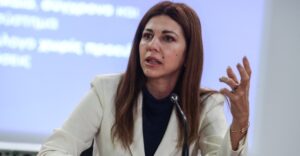
Speaking at the annual conference organized by the Association of Owners of Private Radio Stations of Attica (E.I.I.R.A.) under the theme “All Things Radio 2026,” Ilianna Antoniou, Director of Communication and International Relations at AUTODIA – Self-Management, presented the positions of copyright creators regarding the relationship between musical content and Artificial Intelligence, placing copyright at the center of public debate.
As she pointed out, the creative community is facing an unprecedented challenge, as human works are being used to train generative AI systems without creators’ consent and without compensation. As she stressed, these practices amount to theft and unfair competition, leading to a form of cannibalization of creative labor itself.
The mass production of artistic products by AI systems, often as faithful imitations of human works, enters the same market from which human creators make their living.
The result is the gradual substitution of human creativity, with serious consequences for the income and professional future of composers, songwriters, and other creators. As mentioned, estimated revenue losses for creators could range from 40% to 60%, particularly in sectors such as streaming and audiovisual productions.
Ms. Antoniou reminded the audience that under current legislation, only a human being is recognized as the intellectual creator of a work, and only then do copyright protections arise. Nevertheless, in practice it is becoming increasingly difficult to distinguish between human and artificial musical works, as AI-generated content is often not labeled as such. Transparency therefore emerges as a critical demand for both creators and the public.
More than 13.4 Million Tracks Removed from Platforms
At this point, her remarks were accompanied by specific data. According to studies she cited (AUTODIA-ALCO and Deezer-Ipsos), the overwhelming majority of listeners state that they want to know whether the song they are listening to was produced by Artificial Intelligence or by a human creator.
This knowledge allows listeners to seek out the creator behind the work, connect with them, or, if they wish, choose to skip content produced entirely by AI. The demand for transparency and fairness toward artists is thus recorded as a clear social requirement.
Particular emphasis was also placed on the scale of AI-generated music production.
As Ms. Antoniou noted, in 2025 alone more than 13.4 million music tracks produced entirely by Artificial Intelligence were identified and removed from streaming platforms, with special labeling.
The upload rate reaches approximately 60,000 new AI compositions per day, illustrating the mass scale and speed with which the phenomenon is entering the market.
These figures, she stressed, are not neutral for the cultural and creative sector. The substitution of human creativity by mass-produced AI content threatens the sustainability of professionals operating in a sector with substantial economic and social contribution.
The cultural and creative sector contributes approximately 4% to European GDP and employs around 8.5 million workers across Europe. Its weakening affects not only creators but also a broader chain of professions and activities connected to culture and media.
Within this context, Ms. Antoniou highlighted the role of radio as a medium that continues to rely on human connection, trust, and live interaction with listeners. The personal selection of music, the producer’s voice, commentary, analysis, humor, and empathy remain elements that cannot be replaced by algorithms. Radio functions as a carrier of language, song, and music as lived experience, rather than as a mere set of data.
She concluded with the message that copyright creators are not opposed to innovation, but in favor of fairness and the responsible use of Artificial Intelligence. The protection of copyright and the clear distinction between human and artificial creation, she emphasized, are prerequisites for maintaining a vibrant cultural chain—one that connects creators, radio, and audiences through authentic human stories and genuine trust.
The event was held at the Library of Parliament (former Public Tobacco Factory) and brought together numerous professionals from the fields of radio production, market research and marketing, advertising, and advertisers’ associations, while also hosting institutional representatives and international market experts.
According to the announcement, attendees included Konstantinos Fotopoulos, President of E.I.I.R.A., and Ioannis Bratakos, President of the Athens Chamber of Commerce and Industry. Representing the government were Pavlos Marinakis, Deputy Minister to the Prime Minister and Government Spokesperson, and Dimitris Papastergiou, Minister of Digital Governance. From AUTODIA, those present also included Gioulina Manolatou, Head of Marketing; Giorgos Stabolis, Director of Digital Strategy & Business Development; Dimitris Varouxis, Head of Radio and Television Media; and Stathis Pantzis, Head of Online Media.
AUTODIA executives held meetings with many industry professionals and informed the public about the Organization’s activities, providing specialized information and printed materials.
AUTODIA (Self-Management) is a Greek Collective Management Organization (CMO) that protects the copyrights of Greek and foreign composers, lyricists, and music publishers. It represents the entirety of the foreign repertoire and the vast majority of the Greek repertoire, having signed representation agreements with 85 CMOs worldwide.
Ask me anything
Explore related questions