




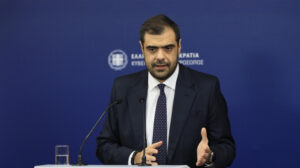
The reaction of government spokesman Pavlos Marinakis was provoked by what Nikos Androulakis said today about Türkiye, the SAFE program, and Greece’s role in not joining it.
Marinakis accused the PASOK president of “distorting the truth” and telling “gross lies” by analyzing how it was Greece that put up barriers to Türkiye joining the European Union’s SAFE defense program.
“Mr. Androulakis may have chosen the slippery slope of attempted misleading, but he must realize that there is a limit to everything. And this limit is the national issues, because in these matters ignorance and oppositional obsession becomes extremely dangerous”, concludes Mr. Marinakis in his statement.
Full statement by Marinakis on Androulakis’ statements
It is not the first time (and unfortunately, probably not the last) that PASOK of Mr Androulakis invests in distorting the truth and altering reality with gross lies. It is a standard tactic, which citizens have come to understand and despise. But when it comes to our national issues and the country’s foreign policy, such practices cannot and should not go unanswered.
In an interview with ANT1 today, the PASOK president, in a display of irresponsibility and hypocrisy, claimed that it was not Greece that put up barriers for Turkey to join the European Union’s SAFE defense plan, but the interests of major European countries.
To begin with, it is admirable that Mr. Androulakis is making a new caveat, having until recently proclaimed that the SAFE Regulation “opens the door” to third countries. He was even proclaiming that the clear position of Prime Minister Kyriakos Mitsotakis that “as long as there is a casus belli, there is no chance for Türkiye to enter SAFE” was a pretext and could be overcome by Ankara with a temporary lifting of the casus belli.
So, because reality has once again contradicted Mr Androulakis and his party, the PASOK president has attempted yet another false move. But one only has to read the original version of the draft SAFE Regulation to realise that it included all third countries in total, without any classification. Indeed, as this Regulation had strong support from major countries, it could have been adopted with this content, as a qualified majority was required, which it obviously was.
However, it was Greece’s strong stance in COREPER and in the Foreign Affairs Council that was the reason for adding to the provisions of the Regulation the obligation for any third country participating in SAFE to conclude a bilateral agreement with the European Union. And, indeed, it was expressly provided that this bilateral agreement must be unanimously accepted by all Member States of the Union, on the basis of Articles 212 and 218 of the Treaty on the Functioning of the European Union. In other words, a veto right of each Member State of the Union was created from scratch and based on Article 17 of the Regulation.
This development is, beyond any doubt, a major success of Greek diplomacy – a national success. Mr Androulakis may have chosen the slippery slope of attempted deception, but he must realise that there is a limit to everything. And that limit is national issues, because in these matters, ignorance and oppositional obsession become extremely dangerous.
Ask me anything
Explore related questions