





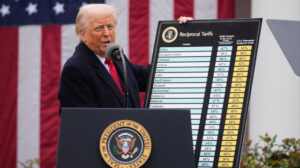
U.S. President Donald Trump made clear yesterday (Wednesday) that he intends to move forward with additional customs duties “on microcircuits and semiconductors,” without specifying for now when the measure would take effect.
“We’re going to put big customs duties on microcircuits and semiconductors,” the Republican told reporters at the White House, “about 100 percent,” which he called “good news for U.S. companies that make those items.
The U.S. government collected nearly $30 billion in tariff revenue last month, according to the Treasury Department. That’s an increase of 242% in tariff revenue compared with last July.
Since April, when the president began imposing 10% tariffs on nearly all goods, among several other tighter tariffs that followed, the government has collected a total of $100 billion in tariff revenue, triple the amount it collected during the same four months last year.
So what exactly is the government doing with all that money?
Trump has proposed a combination of two options: paying off the government’s multi-trillion-dollar debt and sending “rebate checks” to Americans.
“The purpose of what I’m doing is primarily to pay down the debt, which will happen in very large amounts,” Trump said Tuesday. “But I think there’s also the possibility that we’re going to collect so much money that we may very well pay a dividend to the American people.”
Neither has happened – at least not yet. So, to many Americans, it may seem that the billions of dollars coming in from tariffs, which come mostly out of the pockets of American businesses that pay the initial bills for importing foreign goods, are gathering dust.
But there is much more going on behind the scenes.
What’s happening with tariff revenues
Whatever revenue the government collects, through ordinary taxes or tariffs, is deposited into a general fund managed by the Treasury. The Treasury refers to this fund as “America’s checkbook” because it is used to pay the government’s bills, such as Social Security payments.
When the amount of revenue the government receives falls short of its bills, which means it has a budget deficit, it borrows money to make up the difference. In total, the government is required to repay more than $36 trillion, an amount that is steadily increasing, raising alarm among many economists who claim it is negatively affecting economic growth.
That’s because, like every American who borrows money, the government has to pay interest on its loans. The more the government borrows, the more interest it has to pay back, which is another expense the government has to pay that doesn’t go to public good investments like highway improvements.
While the tariff revenue collected is not enough to eliminate the $1.4 trillion budget deficit the government is running for the current fiscal year, tariff collections have caused that number to shrink. That means the government doesn’t have to resort to borrowing as much money as it otherwise would have without the tariff revenues.
“It’s not that there’s a better use of money,” Brett Ryan, a senior U.S. economist at Deutsche Bank, told CNN, referring to the tariff revenue.
While tariff revenues may help the government’s financial situation on paper, they are not necessarily painless.
Businesses, for the most part, absorb higher costs without raising prices. But that’s not true for every business. Appliances, toys, consumer electronics, tariffs and other goods that are sensitive to tariff changes are becoming more expensive, according to recent inflation reports released by the government. And many companies, including Walmart and Procter & Gamble, are warning of coming price increases.
Ask me anything
Explore related questions


