






The essence of the latest polling data lies in the fine print, as recent surveys place the “party of the undecided” in second place, amid a period of universal decline in the appeal of traditional political parties. Drawing systematic support from across the political spectrum, the number of undecided voters is steadily increasing, exhibiting diverse demographic characteristics. However, they are reluctant to reveal their preferences before the official start of the pre-election period.
1. MRB Poll
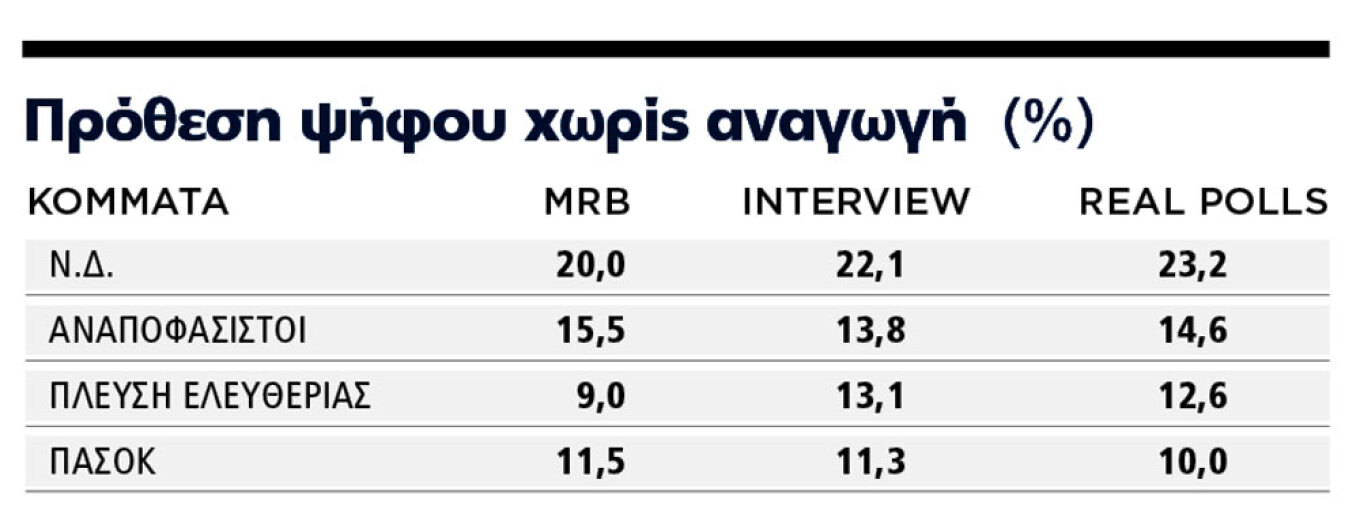
In just the last ten days, polling data has recorded undecided voters at one of their highest levels, with unallocated votes reaching 25.2% in the latest MRB poll’s adjusted voting intention. This finding becomes even more intriguing for party strategists when considering the adjusted results: New Democracy holds 26.7%, followed by PASOK at 15.4%, failing to break the psychological barrier of 20%.
At the same time, 29.4% of the undeclared votes from the 2024 elections are now going to Zoe Konstantopoulou’s “Plefsi Eleftherias” (Course of Freedom) party, placing it in third place with 12%—a figure significantly higher than in the European elections.
2. Interview Poll
The “party of the undecided” also ranked second in the latest Interview poll, published midweek, where 13.8% of respondents declared they were still unsure about their vote in the next elections. Meanwhile, 3% stated they would vote for “another party,” a trend similar to the most recent European elections.
In terms of voting intention, the undecided group ranks second in this survey, with New Democracy leading at 22.1% and Plefsi Eleftherias at 13.1%. In the vote estimate, these figures rise to 25.8% and 15.2%, respectively.
Based on data analysis, more than 25%-30% of undecided voters in the Interview poll are believed to have previously supported New Democracy, making it the only party with a real chance of reclaiming them during the election campaign. However, experts estimate that many undecided voters will remain uncertain for an extended period, given that the next elections are two years away—an interval that introduces significant electoral volatility.
For researchers, the high percentage of undecided voters is also attributed to the “wide array of choices” created by the fragmentation of the political landscape, particularly on the progressive side. “There is now a party for every preference—something that was not the case during the post-dictatorship era and the period of strong bipartisanship,” a polling expert told Proto Thema. Furthermore, the breakdown of traditional party loyalties allows for unexpected voter shifts—such as right-wing voters moving toward the left and vice versa.
Unlike the past, the undecided voter pool now includes citizens from various political backgrounds, with the highest voter consolidation in the Interview poll recorded for Plefsi Eleftherias at 79.6%.
Similarly, New Democracy’s consolidation rate stands at 77.9% in the vote estimate, while PASOK follows at 72.4%. In stark contrast, SYRIZA shows a consolidation rate of just 28.3%, marking a historic low for the once-governing party.
SYRIZA’s “bleeding” is largely due to voter migration—27% of its previous supporters have shifted to Stefanos Kasselakis’ Movement for Democracy, while a segment of its traditional base has also contributed to the growing ranks of the undecided.
3. Real Polls Survey
The “party of the undecided” remains firmly in second place in the latest Real Polls survey, with 14.6% of respondents stating they have not yet decided on their vote. An additional 2.5% responded with “Don’t know/No answer” when asked about their voting intention.
In this context, New Democracy leads in voting intention at 23.2%, followed by Plefsi Eleftherias at 12.6%—a percentage lower than that of the undecided voters.
Other Party Preference
Even in Real Polls’ electoral outcome forecast, a segment of the electorate remains uncharted, as 4.1% stated they would vote for “another party.” Meanwhile, four parties hover around the 3% threshold: Voice of Reason at 3.7%, MeRA25 at 3.3%, Victory (NIKI) at 3.1%, and Movement for Democracy at 3.1%.
The extent of electoral volatility indicated by the high percentage of undecided voters is further highlighted in Real Polls’ study. When asked in a hypothetical scenario—”If all parties had a different leader than they currently do, which party would you vote for?”—20% answered “Don’t know/No answer,” while 9.2% responded with “Another party.” Meanwhile, New Democracy polled at 22.1% and PASOK at 18.4%, indirectly revealing the parties’ intrinsic strength beyond their leaders.
Notably, Zoe Konstantopoulou leads in popularity among political leaders, with a 33.4% favorability rating, ahead of Communist Party leader Dimitris Koutsoumbas (28.2%) and Prime Minister Kyriakos Mitsotakis (26.5%).
While a portion of undecided voters ultimately opt for abstention rather than heading to the polls, analysts currently view women and young voters as key demographic factors that could influence election outcomes, particularly in terms of voter turnout.
Ask me anything
Explore related questions