




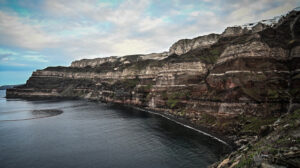
Measurements are ongoing due to the continuous seismic activity, which is still developing, stated Associate Professor of Geological Oceanography and Physical Geography at the Department of Geology and Geoenvironment of the National and Kapodistrian University of Athens (NKUA), Evi Nomikou, while en route to Santorini early in the morning, speaking to Proto Programma.
“Yesterday, we had two earthquakes of 4.2 and 4.4 magnitude on the Richter scale. As we have already informed the public, since we are experiencing ongoing seismic activity, we must be prepared to respond according to the instructions of the state mechanism on how to deal with an earthquake. Let’s not forget that all of this is occurring in the marine area northeast of Santorini. This is a known seismogenic zone, with many fault zones and numerous faults that have been activated. According to the committee’s report yesterday, we are observing some very deep magmatic processes—molten material and fluids that, as always, rise toward the surface, causing gravitational movements. As a result, the faults are shifting.
Of course, these are new findings, the result of years of research. That’s why we always emphasize the importance of relying on data. After analyzing all the available data, we developed this tectonic model, which we presented to the committee. It provides us with a clearer understanding of what is happening in the marine area. However, research is ongoing. We are now heading to retrieve the underwater seismographs and deploy two new ones because seismic activity continues, and it is crucial to precisely locate the epicenters and identify which fault zones are currently active,” Nomikou explained.
While acknowledging that there has been a reduction in the number of earthquakes, Nomikou stressed that as long as seismic activity persists, “we must remain extremely cautious, which is why schools remain closed.”
“It is certain that these phenomena will continue to affect the region for several more weeks,” she added.
On Magmatic Processes
Nomikou further clarified:
“We should not confuse volcanic activity with magmatic processes occurring deep within the Earth. That is why, from the very beginning, we stated that this is a complex geological phenomenon, difficult to explain to those without a background in geology, seismology, or volcanology. Magmatic processes deep within the Earth are always occurring. That is entirely different from a volcanic eruption at the surface, whether on the seabed or at Nea Kameni.
We are dealing with a marine area where all these processes are currently taking place. Above it lies the small island of Anydros, which consists of limestone—it is not a volcano. Therefore, these large earthquakes are not occurring within the central caldera of Santorini, where there is an actual volcano, Nea Kameni. If that were the case, we would be placing the volcano on high alert—orange or red, as we say in volcanology.
This is why both the public and scientists need to remain calm. We are actively studying various scenarios, but these are not things that the general public needs to worry about. There is no need for catastrophic predictions, as unnecessary alarmism has already unsettled people,” Nomikou added.
“We are observing fluid migration linked to deep magmatic processes—this means fluid movement, not magma rising to the surface. There is no cinematic eruption scenario where we would suddenly witness a massive explosion, cameras rolling. We must remain level-headed.
This is something we have repeatedly urged among scientists—our conclusions must always be based on data. Those of us who have been working at sea for many years, gathering geophysical and seismic profiles—essentially images of the Earth’s subsurface—analyze and integrate these data, which is why we provide continuous updates. The models currently running, including the one we presented, are the result of a long and rigorous scientific process.
This is not something that happens overnight. We meticulously process the data to ensure accurate and safe information for both the authorities and the local community,” Nomikou emphasized.
Upcoming Scientific Meetings
“On Wednesday evening, we will meet again. These meetings have become more frequent because we are continuously collecting data from various scientific teams. Additionally, we are analyzing information from previous oceanographic missions. The most recent one took place in December 2024 aboard a major German research vessel.
We are also awaiting results from the HCMR oceanographic vessel Aegean, which we have not yet received, as the research team is still conducting their expedition,” Nomikou concluded.
Ask me anything
Explore related questions