

×
GreekEnglish

×
  • Politics
  • Diaspora
  • World
  • Lifestyle
  • Travel
  • Culture
  • Sports
  • Cooking
Sunday
18
Jan 2026
weather symbol
Athens 6°C
  • Home
  • Politics
  • Economy
  • World
  • Diaspora
  • Lifestyle
  • Travel
  • Culture
  • Sports
  • Mediterranean Cooking
  • Weather
Contact follow Protothema:
Powered by Cloudevo
> World

NASA warns of 3 skyscraper-sized asteroids headed toward Earth this week

Thankfully, they'll all miss

Newsroom February 28 06:56

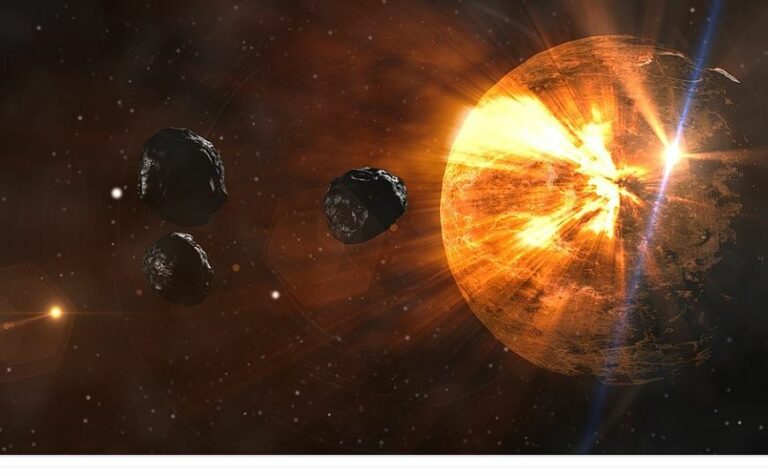
A trio of enormous asteroids, including two ‘potentially hazardous’ ones, will cross Earth’s orbit around the sun this week, according to NASA. Here’s what that means.

Our solar system is home to millions of renegade space rocks, and this week three particularly large ones will blaze past Earth. But don’t worry – the closest one will still miss our planet by a comfy 2.2 million miles (3.5 million kilometers), or about 10 times the average distance between Earth and the moon, according to NASA.

On Monday (Feb. 27), an asteroid named 2012 DK31 will sail past our planet at a distance of about 3 million miles (4.8 million km). The asteroid measures an estimated 450 feet (137 meters) across, or about as wide as a 40-story skyscraper is tall, and its orbit around the sun crosses Earth’s orbit every few years.

also read

Top Tavernas on Skopelos Island

>Related articles

Erich von Däniken, Swiss bestselling author who linked ancient civilizations to extraterrestrials, dies at 90

Sick astronaut on mission – NASA considers early return of International Space Station crew

Who were the predators on Earth before the dinosaurs

Greek Conductor to lead Byzantine Chant Ensemble in King Charles III Coronation

Although the space rock poses no imminent threat to Earth, NASA classifies it as a potentially hazardous asteroid (PHA) – meaning the rock is large enough and orbits close enough to Earth that it could cause serious damage if its trajectory changed and a collision occurred. Generally, any asteroid measuring greater than 450 feet wide and orbiting within 4.6 million miles (7.5 million km) of Earth is considered a PHA. (NASA has mapped this asteroid’s trajectory for the next 200 years, and no collisions are predicted to occur).

more at livescience.com

Ask me anything

Explore related questions

#asteroids#earth#nasa
> More World

Follow en.protothema.gr on Google News and be the first to know all the news

See all the latest News from Greece and the World, the moment they happen, at en.protothema.gr

> Latest Stories

What Trump is seeking with the extra tariffs on eight European countries for Greenland, the trade deal with the EU is in the air

January 18, 2026

The global era of Messinia: How the film Odyssey and the lists of major media praise it for 2026

January 18, 2026

Greek exports broke records with a record 37 billion euros

January 18, 2026

Sakkari delivers the ‘point of the year’ as she advances at the Australian Open

January 18, 2026

New legal migration rules for 90,000 pending residence permits

January 18, 2026

Weather: Why the new cold wave brings little snow until Tuesday – Stronger weather deterioration expected from Wednesday

January 18, 2026

War, diplomacy, or insurrection: What’s next in Iran

January 17, 2026

New tensions in the Middle East as Trump invites regional leaders to the Gaza Peace Council

January 17, 2026
All News

> Lifestyle

A treat for readers: Dior, bags, and literature

The fashion house Dior starts 2026 with a dreamy new campaign

January 16, 2026

Sophie Turner’s first photo as Lara Croft released for Tomb Raider series

January 15, 2026

Vicky Chatzivasileiou: “I never gave up anything for television — It’s not my whole life”

January 15, 2026

Nikki Glaser reveals jokes cut from her Golden Globes hosting set

January 15, 2026

Next-level skylines: The towers transforming cities in 2026

January 13, 2026
Homepage
PERSONAL DATA PROTECTION POLICY COOKIES POLICY TERM OF USE
Powered by Cloudevo
Copyright © 2026 Πρώτο Θέμα