

×
GreekEnglish

×
  • Politics
  • Diaspora
  • World
  • Lifestyle
  • Travel
  • Culture
  • Sports
  • Cooking
Friday
23
Jan 2026
weather symbol
Athens 13°C
  • Home
  • Politics
  • Economy
  • World
  • Diaspora
  • Lifestyle
  • Travel
  • Culture
  • Sports
  • Mediterranean Cooking
  • Weather
Contact follow Protothema:
Powered by Cloudevo
> World

Scientists observe long, curvy jet coming from a Quasar across the universe

Using the world-spanning Event Horizon Telescope, researchers were able to study an enormous jet of electromagnetic radiation

Newsroom February 15 12:46

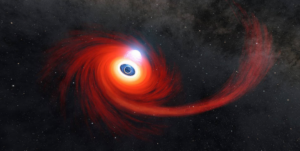
The Event Horizon Telescope, which brought us the first-ever image of a black hole and the first view of the supermassive black hole at the center of our galaxy, has inspected a much brighter target: a quasar. Quasars are extremely luminous objects that are powered by matter spiraling into huge black holes. These active galactic nuclei, as they’re called, spew electromagnetic radiation out into space—and the EHT team might have just peered inside one.

A global collaboration of scientists studied NRAO 530, a quasar about 7.5 billion light-years away, which, according to the team, is the most distant object yet imaged with the Event Horizon Telescope. Using the telescope array, the researchers, led by Svetlana Jorstad from Boston University’s Institute of Astrophysical Research, observed some of the quasar’s features. Specifically, they imaged a jet of radio-wavelength radiation that spans 1.7 light-years.

The research team also observed the quasar’s core, where the jet begins, and two mysterious structures within the core that the scientists couldn’t see properly with the telescope’s current capabilities. The jet also features a magnetic field that likely has a helical pattern to it, or some kind of curvature, according the team’s measurements of the light emitted from the jet.

“The outermost feature has a particularly high degree of linear polarization, suggestive of a very well ordered magnetic field,” said Jorstad in a statement.

See Also:

Step towards quantum computers “which could break the internet”

>Related articles

Portugal on high alert due to severe weather, waves expected to reach 15 meters

Lagarde thanked those who criticize Europe: “It is an opportunity for self-assessment,” she said

Trilateral US-Russia-Ukraine talks begin in Abu Dhabi, with the Donbas issue at the center

One of the key methods Jorstad and the research team used to image the quasar is called Very Long Baseline Interferometry, or VLBI. Telescopes spread across the planet in an array, like the ones that make up the Event Horizon Telescope, can all capture radio signals from the same astronomical source. Astronomers using a VLBI methodology can then collect these different data points and account for any difference in detection time (data from a source might be collected at one telescope slightly before its collected at another telescope) in order to build a detailed image of the target.

Astrophysicists are learning more about quasars thanks to new observing tech like EHT and the recently launched Webb Space Telescope. Images from Webb released last fall revealed a polychrome quasar whose galaxy is interacting with three others in a galactic “knot.” And back in 2020, the Hubble Space Telescope observed quasar “tsunamis,” which researchers think could be powerful enough to shut off galaxy formation.

Source: Gizmodo

Ask me anything

Explore related questions

#astronomy#astrophysics#physics#Quasar#science#space#technology#universe#world
> More World

Follow en.protothema.gr on Google News and be the first to know all the news

See all the latest News from Greece and the World, the moment they happen, at en.protothema.gr

> Latest Stories

Greece–Türkiye: Cautious diplomacy ahead of the Cooperation Council

January 23, 2026

Donbas: The “Greenland” Putin is determined to secure — Zelensky’s red line

January 23, 2026

Watch video: Footage of French forces boarding a Russian “shadow fleet” tanker in the Mediterranean

January 23, 2026

Pierrakakis praises AADE’s innovative model as a blueprint for modernizing Greek public administration

January 23, 2026

‘We lost an angel, she will be dressed as a bride,’ said Christina’s father, who lost her life in Ano Glyfada

January 23, 2026

Meloni: ‘Europe has more to lose than gain by clashing with Trump’

January 23, 2026

The dirty side of Pompeii: baths filled with sweat and urine, according to a new study

January 23, 2026

Christodoulides meeting with ExxonMobil’s vice president, 6-9 trillion cubic feet of natural gas estimated in Block 10

January 23, 2026
All News

> Politics

Greece–Türkiye: Cautious diplomacy ahead of the Cooperation Council

Athens and Ankara regulate the details of the conference before February 18, with the aim - despite the unfavourable climate - to keep the channels of communication open, but also to avoid major crises between the two countries.

January 23, 2026

Mitsotakis to Euronews after the EU Summit: Transatlantic relations are complex, Trump’s comments on de-escalation were positive (video)

January 23, 2026

Mitsotakis’ delicate balancing act after the crisis of trust in Euro-American relations

January 23, 2026

Metron Analysis: from 12.9% to 16%, the lead of ND in one month, 50% for Karstianos’ popularity

January 22, 2026

Mitsotakis: ‘Yes to 13 Countries Joining the Peace Council — but Only for Gaza’

January 22, 2026
Homepage
PERSONAL DATA PROTECTION POLICY COOKIES POLICY TERM OF USE
Powered by Cloudevo
Copyright © 2026 Πρώτο Θέμα