

×
GreekEnglish

×
  • Politics
  • Diaspora
  • World
  • Lifestyle
  • Travel
  • Culture
  • Sports
  • Cooking
Saturday
24
Jan 2026
weather symbol
Athens 11°C
  • Home
  • Politics
  • Economy
  • World
  • Diaspora
  • Lifestyle
  • Travel
  • Culture
  • Sports
  • Mediterranean Cooking
  • Weather
Contact follow Protothema:
Powered by Cloudevo
> World

Scientists grow cells on a robot skeleton, but don’t know what to do with them yet

A new method of tissue engineering is only a proof of concept for now

Newsroom May 27 12:00

The science of tissue engineering — or growing human cells for use in medicine — is very much in its infancy, with only the simplest lab-grown cells able to be used in experimental treatments today. But researchers say a new method of tissue engineering could potentially improve the quality of this work: growing the cells on a moving robot skeleton.

Typically, cells used in this sort of regenerative medicine are grown in static environments. Think: petri dishes and miniature 3D scaffolds. A few experiments in the past have shown that cells can be grown on moving structures like hinges, but these have only stretched or bent the tissue in a single direction. But researchers from the University of Oxford and robotics firm Devanthro thought that, if you want to grow matter designed to move and flex like tendons or muscles, it’d be better to recreate their natural growing environment as accurately as possible. So they decided to approximate a mobile human body.

See Also:

>Related articles

Portugal on high alert due to severe weather, waves expected to reach 15 meters

Lagarde thanked those who criticize Europe: “It is an opportunity for self-assessment,” she said

Trilateral US-Russia-Ukraine talks begin in Abu Dhabi, with the Donbas issue at the center

Russia shot down Ukrainian military transport plane with foreign weapons

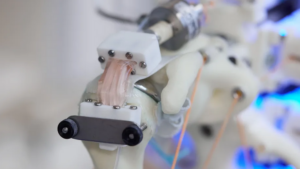
Growing cells in an actual person creates all sorts of difficulties, of course, so the cross-disciplinary team decided to approximate the human musculoskeletal system as best they could using a robot. As described in a paper published in Communications Engineering, they adapted an open-source robot skeleton designed by the engineers at Devanthro and created a custom growing environment for the cells that can be fitted into the skeleton to bend and flex as required. (Such growing environments are known as bioreactors.)

Read more: The Verge

Ask me anything

Explore related questions

#robots#science#technology#tissue#world
> More World

Follow en.protothema.gr on Google News and be the first to know all the news

See all the latest News from Greece and the World, the moment they happen, at en.protothema.gr

> Latest Stories

The Shackled Men of Phaleron: This is what the space that will host the major archaeological find will look like – Photos

January 24, 2026

Weather: Storms and muddy rain arriving from Sunday – when Attica will be affected

January 24, 2026

Castello’s “odyssey” in the Mediterranean: A sea turtle from Greece found in Spain

January 24, 2026

According to Corriere della Sera, the US has proposed offering $800 billion and security guarantees to Zelensky in exchange for his agreement regarding Donbas

January 24, 2026

Chia seeds and quinoa vs. rice and pasta: Which are the healthier choices

January 24, 2026

Stefi: ‘The song I sent to Eurovision is about the unity of people across Europe

January 24, 2026

Owner of Crans-Montana tragedy bar released after posting over €200,000 bail

January 23, 2026

Greece–Türkiye: Cautious diplomacy ahead of the Cooperation Council

January 23, 2026
All News

> Lifestyle

Stefi: ‘The song I sent to Eurovision is about the unity of people across Europe

The singer will present her song in the first semi-final of Sing for Greece 2026 on February 11

January 24, 2026

A final farewell to fashion icon Valentino with white roses: Wintour, Versace, and Hathaway say goodbye

January 23, 2026

How old are your lungs? The simple at-home test that gives the answer

January 22, 2026

Farah Diba Pahlavi, the story of Iran’s first and last “empress”

January 22, 2026

Fotini Pelouso: Her roots in Thebes, the hardest Greek word, and her favorite scene in ‘The Great Chimera’

January 22, 2026
Homepage
PERSONAL DATA PROTECTION POLICY COOKIES POLICY TERM OF USE
Powered by Cloudevo
Copyright © 2026 Πρώτο Θέμα