




Is Ukraine the new Greece? The wave of pro-Ukrainian sentiment unleashed over past weeks by Russia’s invasion, manifesting not just in economic and financial sanctions undertaken by governments, but also in the blue-and-yellow flags draped in businesses and Twitter bios, calls to mind a similar phenomenon from almost exactly two centuries ago, as Greek rebels rose up against Ottoman rule in the 1820s. Foreign support for the Greek uprising has served ever since as the blueprint for campaigns in favour of intervention abroad, argues British historian Mark Mazower in his sweeping new history, The Greek Revolution: 1821 and the Making of Modern Europe. Could today’s discourse around Ukraine still be following a pattern set in the early 19th century?
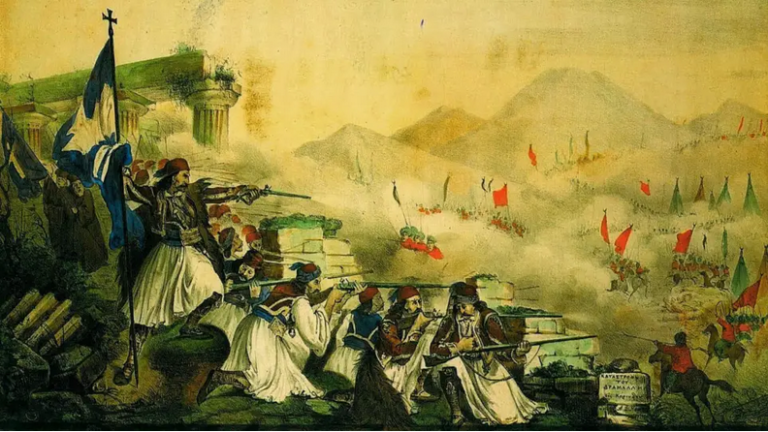
In question then, as now, was the fate of a territory at the periphery of Europe with regard to a declining but still imposing power straddling Europe and Asia. As Ottoman forces clashed with Greek rebels for years after the outbreak of revolution in 1821, European liberal opinion was impressed by the Greeks’ pluckiness in resisting a much larger force on their home territory – and horrified by reports of Ottoman atrocities. The Greek cause suited Romantic ideas then in vogue in Europe, enticing many “philhellenes”, as supporters of Greece were called, including Lord Byron, to join the struggle. There was real bravery on display by Greeks throughout the revolution – but there were darker tendencies at play, too, and many philhellenes, encountering shocking brutality on both sides, quickly lost the simple sense of moral clarity they had set out with..
Ukraine achieved its independence after a referendum was held in 1991 as the Soviet Union collapsed. In 19th-century Greece, however, there was neither the infrastructure nor the appetite on the part of Ottoman rulers to hold a vote. Greece’s journey to independence began instead with a popular uprising – planned by a secret organisation called the Friendly Society, which drew its ideas from the French Revolution and harboured a vision of restoring the grandeur of ancient Greece. But the uprising soon spiralled out of the society’s control as Greeks took matters into their own hands.
Mystras of Aegina – Amazing drone footage of 50 churches (video)
For most of the Greek people, largely made up of illiterate peasants, revolt against the Ottomans did not reflect hopes for an independent national state – something that one would have struggled to explain to them – but rather a chance to “make the romeïko”. The romeïko, in popular conception, was an event with eschatological religious connotations that involved throwing off the Ottoman yoke and taking back Constantinople, reinstating not Athenian democracy but the Byzantine Empire.
Part of what is so remarkable about the Greek revolt is how it managed to fuse popular Orthodoxy and the vanguard Hellenism of the Friendly Society into a syncretic popular nationalism – the first of a kind that would soon sweep the world. As the revolution went on Greeks began crying “Ellas anesti” (“Greece is risen”) – a twist on the Orthodox Easter refrain of “Christos anesti” (“Christ is risen”). After hoped-for Russian support failed to materialise and the prospect of taking back Constantinople faded away, popular sentiment remained in favour of revolt, the goal of which slowly transformed from romeïko to independence.
Read more: New Statesman
Ask me anything
Explore related questions