

×
GreekEnglish

×
  • Politics
  • Diaspora
  • World
  • Lifestyle
  • Travel
  • Culture
  • Sports
  • Cooking
Friday
16
Jan 2026
weather symbol
Athens 15°C
  • Home
  • Politics
  • Economy
  • World
  • Diaspora
  • Lifestyle
  • Travel
  • Culture
  • Sports
  • Mediterranean Cooking
  • Weather
Contact follow Protothema:
Powered by Cloudevo
> World

23,000-Year-Old Human Footprints Discovered in New Mexico

The footprints were formed in soft mud on the margins of a shallow lake which now forms part of a large playa called Alkali Flat

Newsroom September 27 11:40

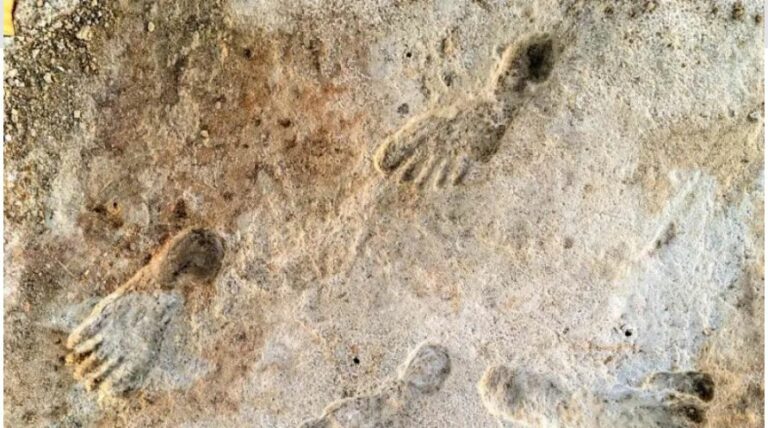
In a study of exposed outcrops of Lake Otero in New Mexico, the United States, archaeologists have discovered numerous human footprints dating to about 23,000 to 21,000 years ago. The discovery confirms the presence of humans in North America during the Last Glacial Maximum, adding evidence to the antiquity of human colonization of the Americas.

“Archaeologists and researchers in allied fields have long sought to understand human colonization of North America,” said Bournemouth University’s Professor Matthew Bennett and colleagues.

“Questions remain about when and how people migrated, where they originated, and how their arrival affected the established fauna and landscape.”

In the new study, the researchers examined the ancient human footprints in White Sands National Park in New Mexico.

The footprints were formed in soft mud on the margins of a shallow lake which now forms part of a large playa called Alkali Flat.

They were first discovered by David Bustos, a resources manager at White Sands National Park.

also read

Videos of the moment the earthquake hit Crete emerge

>Related articles

Mexico: 76 dead from floods and landslides – 27 people missing

Alert in the U.S. over the parasitic “screwworm fly” – First human case detected

Canada to lift retaliatory tariffs on U.S. goods starting September 1

“It is incredible to have the confirmation on the age of the human prints, and exciting but also sad to know that this is only a small portion of the 80,000 acres where the prints have been revealed bare and are also being rapidly lost to ongoing soil erosion,” Bustos said.

The scientists dated the footprints using radiocarbon dating of seed layers above and below the footprint horizons.

more at sci-news.com

Ask me anything

Explore related questions

#ancient human footprints#mexico
> More World

Follow en.protothema.gr on Google News and be the first to know all the news

See all the latest News from Greece and the World, the moment they happen, at en.protothema.gr

> Latest Stories

A treat for readers: Dior, bags, and literature

January 16, 2026

Greek firms secure key roles in Libya’s reconstruction

January 16, 2026

Why Trump hasn’t “pressed the button” to attack Iran: White House and allies doubt it will weaken the Iranian regime

January 16, 2026

Latsis Group: This is the new project of Aura Residential’s 219 apartments in Elliniko

January 16, 2026

Marinakis: Anestidis has no place in a meeting with Mitsotakis; The video with insults crosses the line of decency

January 16, 2026

Mercosur agreement sparks concern over olive export tariffs: Greek and European producers face 12.6% duty

January 16, 2026

Industry: Energy deadlock after Commission’s “no” to Italian pricing model

January 16, 2026

Gerapetritis: ‘Extension of territorial waters will come, as marine parks and spatial planning’

January 16, 2026
All News

> Travel

Kimolos wins over International Media: “A hidden gem waiting to be discovered”

Despite its small size, Kimolos is full of character and charm — and now international media are urging travelers to put this Cycladic island on their bucket list

August 28, 2025

French Vogue discovers the exotic beauty of Skopelos

August 28, 2025

Naxos tops the list of Greek kitesurfing destinations for 2025

July 9, 2025

Holidays in Psara

June 20, 2025

Santorini filled with tourists again (photos)

April 12, 2025
Homepage
PERSONAL DATA PROTECTION POLICY COOKIES POLICY TERM OF USE
Powered by Cloudevo
Copyright © 2026 Πρώτο Θέμα