

×
GreekEnglish

×
  • Politics
  • Diaspora
  • World
  • Lifestyle
  • Travel
  • Culture
  • Sports
  • Cooking
Saturday
24
Jan 2026
weather symbol
Athens 14°C
  • Home
  • Politics
  • Economy
  • World
  • Diaspora
  • Lifestyle
  • Travel
  • Culture
  • Sports
  • Mediterranean Cooking
  • Weather
Contact follow Protothema:
Powered by Cloudevo
> technology

NASA spotted a vast, glowing “Hydrogen Wall” at the edge of our solar system

NASA researchers are pretty sure that New Horizons, the probe that famously skimmed past Pluto in 2015, can see that boundary

Newsroom August 11 02:20

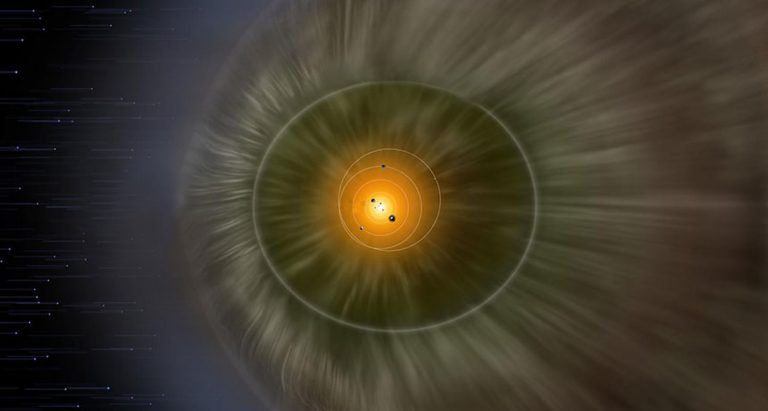
There’s a “hydrogen wall” at the edge of our solar system, and NASA scientists think their New Horizons spacecraft can see it.

That hydrogen wall is the outer boundary of our home system, the place where our sun’s bubble of solar wind ends and where a mass of interstellar matter too small to bust through that wind builds up, pressing inward. Our host star’s powerful jets of matter and energy flow outward for a long stretch after leaving the sun — far beyond the orbit of Pluto. But at a certain point, they peter out, and their ability to push back the bits of dust and other matter — the thin, mysterious stuff floating within our galaxy’s walls — wanes. A visible boundary forms. On one side are the last vestiges of solar wind. And on the other side, in the direction of the Sun’s movement through the galaxy, there’s a buildup of interstellar matter, including hydrogen.

And now NASA researchers are pretty sure that New Horizons, the probe that famously skimmed past Pluto in 2015, can see that boundary.

What New Horizons definitely sees, the researchers reported in a paper published Aug. 7 in the journal Geophysical Research Letters, is some extra ultraviolet light — the kind the researchers would expect such a wall of galactic hydrogen to produce. That replicates an ultraviolet signal the two Voyager spacecraft — NASA’s farthest-traveling probes, which launched in the late 1970s — spotted all the way back in 1992.

However, the researchers cautioned, that signal isn’t a sure sign that New Horizons has seen the hydrogen wall, or that Voyager did. All three probes could have actually detected the ultraviolet light from some other source, emanating from much deeper in the galaxy, the researchers wrote.

But Alice, the instrument on board New Horizons responsible for this finding, is much more sensitive than anything the Voyagers had on board before beginning their own journey out of the solar system, the researchers wrote. And they said they expect Alice to function 15 to 20 more years.

>Related articles

How old are your lungs? The simple at-home test that gives the answer

Elon Musk: Don’t save for retirement – It won’t matter

Sick astronaut on mission – NASA considers early return of International Space Station crew

New Horizons will continue to scan the sky for ultraviolet light twice a year, the researchers wrote, and report what it sees back to Earth.

“If the ultraviolet light drops off at some point, then New Horizons may have left the wall in its rearview mirror,” the researchers explained in an accompanying statement. “But if the light never fades, then its source could be farther ahead — coming from somewhere deeper in space.”

Source: livescience

Ask me anything

Explore related questions

#nasa#planets#science#solar system#space#technology
> More technology

Follow en.protothema.gr on Google News and be the first to know all the news

See all the latest News from Greece and the World, the moment they happen, at en.protothema.gr

> Latest Stories

“The Discombobulator”: Trump’s revelation about the secret weapon the U.S. used during the capture of Maduro in Venezuela

January 24, 2026

New videos show the moment a female employee was struck outside the Vrilissia Hellenic Post (ELTA) office after a dispute over a parcel

January 24, 2026

“Blackout” in the Athens FIR: What really happened on January 4

January 24, 2026

Minimum wage for 2026 enters consultation, target set at €950 by 2027

January 24, 2026

War in Ukraine: Diplomacy in Abu Dhabi, Bombardments in Kyiv and Kharkiv

January 24, 2026

Sydney McLaughlin, world’s best athlete, announces pregnancy: “I created a human with the love of my life”

January 24, 2026

The Shackled Men of Phaleron: This is what the space that will host the major archaeological find will look like – Photos

January 24, 2026

Weather: Storms and muddy rain arriving from Sunday – when Attica will be affected

January 24, 2026
All News

> Politics

Greece–Türkiye: Cautious diplomacy ahead of the Cooperation Council

Athens and Ankara regulate the details of the conference before February 18, with the aim - despite the unfavourable climate - to keep the channels of communication open, but also to avoid major crises between the two countries.

January 23, 2026

Mitsotakis to Euronews after the EU Summit: Transatlantic relations are complex, Trump’s comments on de-escalation were positive (video)

January 23, 2026

Mitsotakis’ delicate balancing act after the crisis of trust in Euro-American relations

January 23, 2026

Metron Analysis: from 12.9% to 16%, the lead of ND in one month, 50% for Karstianos’ popularity

January 22, 2026

Mitsotakis: ‘Yes to 13 Countries Joining the Peace Council — but Only for Gaza’

January 22, 2026
Homepage
PERSONAL DATA PROTECTION POLICY COOKIES POLICY TERM OF USE
Powered by Cloudevo
Copyright © 2026 Πρώτο Θέμα