
×
GreekEnglish

×
  • Politics
  • Diaspora
  • World
  • Lifestyle
  • Travel
  • Culture
  • Sports
  • Cooking
Saturday
17
Jan 2026
weather symbol
Athens 8°C
  • Home
  • Politics
  • Economy
  • World
  • Diaspora
  • Lifestyle
  • Travel
  • Culture
  • Sports
  • Mediterranean Cooking
  • Weather
Contact follow Protothema:
Powered by Cloudevo
> Culture

What ended the Mycenaean era?

A new study into the climatic conditions of the Late Bronze Era sheds light on one of the most significant parts of history in the area

Newsroom May 17 08:57

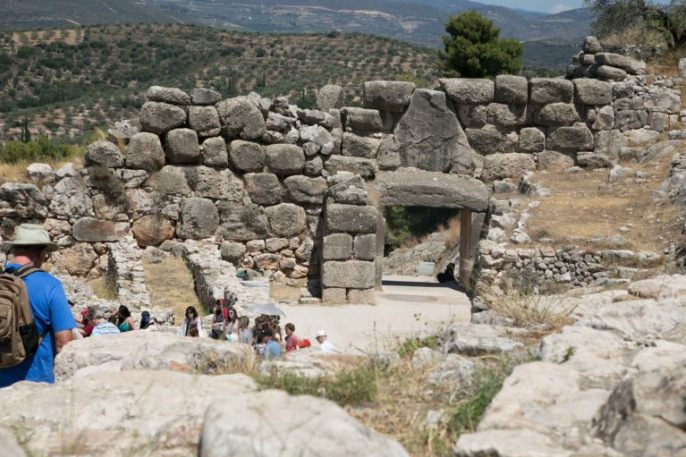
A new study conducted by the Navarino Environmental Observatory (NEO), a research partnership between Stockholm University, the Academy of Athens and TEMES SA reveals that the end of the Mycenaeans, the civilization dominating western Peloponnese in the Late Bronze Age was most likely brought on by an extensive drought.

Researchers Martin Finne and Karin Holmgren, alongside archaeologist Shari Stocker following the analysis of a stalactite from a cave on the islet of Schiza, found that when the palace was destroyed it had already gone through a 20 year long dry period between 1200 and 1180 BC.

The morphology of the layers of the cave stalactite provided a clear picture about the climatic conditions in the eastern Mediterranean at the time with great accuracy.
my1

While NEO agrees that Mycenae suffered from 20 to 80 years of droughts before Pylos saw its demise, the team argues that lack of water was only a “critical component”, not the sole reason for the loss of the civilization.

>Related articles

President of Air Traffic Controllers: Another communications blackout possible in the near future

X is down, thousands report problems

Less alcohol and lower speeds with the new Highway Code and strict fines

“Evidently the centralized administrative system controlled by the palace could survive a relatively short-term dry period and remain in control. Some 50 years later, however, when the pronounced period of aridity started to develop, the system would crumble,” the paper states explaining that the climatic conditions made it hard “for social elites to re-form and for the palatial system to be re-established.”

“The period of drought around 3,200 years [ago] could have contributed to the destabilization of the political and economic order. Increased aridity could have led to reduced agricultural output affecting the finely tuned economic system of a society that was close to, or already, overextended, rattling the very foundations of the fragile palatial economy.”

Source: neoskosmos

Ask me anything

Explore related questions
#archaeology#art#civilization#climate#culture#greece#history#mediterranean#Mycenaeans#Navarino Environmental Observatory (NEO)#Peloponnese#study
> More Culture

Follow en.protothema.gr on Google News and be the first to know all the news

See all the latest News from Greece and the World, the moment they happen, at en.protothema.gr

> Latest Stories

War, diplomacy, or insurrection: What’s next in Iran

January 17, 2026

New tensions in the Middle East as Trump invites regional leaders to the Gaza Peace Council

January 17, 2026

Weather: A return to winter in the coming days – Cold and strong northerly winds – Kolydas’ post

January 17, 2026

A view of Nikolaos Stasinopoulos of Viohalco – The “enduring imprint” of Greece’s greatest industrialist

January 17, 2026

The horror of the “Tariff of the Dead”: how the Iranian regime prices the bodies of protesters

January 17, 2026

Mitsotakis on the Karystianou party: “There is a long distance between being the parent of a tragedy victim and being the leader of a political party”

January 17, 2026

Patras in carnival mode – This evening, the city’s official opening ceremony

January 17, 2026

Greenland as the first line ofdefense for the U.S. and NATO:

January 17, 2026
All News

> World

War, diplomacy, or insurrection: What’s next in Iran

The Iranian regime faces the most serious threat to its survival, despite the repression of protests - The possibility of a US strike remains on the table - The landscape for the next day is blurred

January 17, 2026

New tensions in the Middle East as Trump invites regional leaders to the Gaza Peace Council

January 17, 2026

The horror of the “Tariff of the Dead”: how the Iranian regime prices the bodies of protesters

January 17, 2026

Greenland as the first line ofdefense for the U.S. and NATO:

January 17, 2026

Changes at top universities: Oxford abolishes the term ‘doctores’ for inclusion reasons

January 17, 2026
Homepage
PERSONAL DATA PROTECTION POLICY COOKIES POLICY TERM OF USE
Powered by Cloudevo
Copyright © 2026 Πρώτο Θέμα