




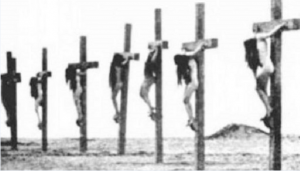
For years, the Armenian-American community has called on US presidents to officially recognize the 1915 mass killings of 1.5 million Armenians by the Ottoman Empire as genocide. Their failure to do so has been a perennial feature of American politics for decades.
And yet, despite his well-known disregard for facts, the one president uniquely positioned to speak the truth after so many of his predecessors have refused is Donald Trump.
This is because of two defining aspects of his approach to international relations: he doesn’t care what other countries think about his foreign policy; and he wants to achieve what he believes his predecessors could not.
We all know the reasons to make this declaration. It’s the right thing to do. It respects historical facts, and appropriately honors those killed. It upholds our values as a nation to speak truth to power. It also answers the call of a key American constituency: the United States is home to roughly 1.5 million Americans of Armenian descent — the second largest population of Armenians outside Armenia. But these reasons have always been there and every modern-day US president surely understood them.
They also understood that such a move would upset Turkey — which vehemently denies that a genocide occurred — and felt it could possibly undermine a number of important joint efforts with the key strategic ally.
President Barack Obama came close to making the genocide declaration several times. At the beginning of his tenure, after promising to make this declaration during his campaign, he decided against making the move because he did not want to disrupt or undermine Turkey-Armenia reconciliation talks that were taking place at the time.
Later in 2015, the Obama administration came close to making the declaration for the 100th anniversary of Armenian Remembrance Day, but the administration was concerned such a move would undermine joint efforts with Turkey to combat ISIS in the region.
President Ronald Reagan is the only sitting US president to have used the word “genocide” in describing the atrocities, and he called on others to follow through on an official recognition — but neither Congress nor subsequent Presidents did this. Like President Obama, President George W. Bush also promised during his presidential campaign that he would make this declaration, but did not.
The United States continues to work with Turkey in a number of ways that support US national security objectives, for example on counterterrorism efforts in Syria. The United States also provides military aid to Turkey and has used the air base at Incirlik to support military operations in the region — a factor that is glaringly significant given the current situation in Syria and related mounting global tension. And of course, although it is unclear how much this matters to President Trump, Turkey is a NATO ally.
Up to this point, the Trump administration has been following the apparent tradition of not making a declaration. President Trump’s statement last year on Armenian Remembrance Day, made weeks before Turkish Prime Minister Recep Tayyip Erdogan’s visit to Washington, like every other such statement before it, fell short of recognizing the Armenian genocide.
But now the time is ripe for President Trump to make the genocide declaration.
First, Turkey’s recent actions go directly against our national security objectives and the resources we have put behind achieving them.
The Turkish government has taken direct military action against Syrian Kurds whom we have armed and supported, and who helped us combat ISIS and successfully remove ISIS’s territorial control in Syria. Beyond that are the concerning authoritarian steps Prime Minister Erdogan has taken within his own borders, such as last year’s constitutional referendum giving the prime minister sweeping executive powers, as well as moves increasingly taken to detain journalists. Let’s not forget his security detail’s indefensible (and illegal) attack against protesters demonstrating in front of the Turkish ambassador’s residence in Washington, DC.
Second, President Trump likely doesn’t care what Turkey thinks anyway, just as he doesn’t care how other countries react to his other foreign policy decisions.
This is illustrated in a number of his foreign policy moves — such as his announcement that the United States will increase tariffs on steel and aluminum, his decision to move the American embassy in Israel to Jerusalem, and his undiplomatic and militaristic tweets on North Korea. So let Trump capitalize on this characteristic and make this declaration his own victory.
Certainly, Turkey is likely to react negatively, even harshly, at first. This could possibly pose risks during American engagement in Syria, but as evidenced by the recent summit in Ankara where Russian President Vladimir Putin, Iranian President Hassan Rouhani, and Prime Minister Erdogan met to discuss Syria, Turkey has appeared to forge an alliance with Russia and Iran in this crisis anyway. Like every other time a nation has recognized the genocide, Turkey will ultimately be forced to move on. Turkey is no stranger to overcoming differences with a country when doing so serves its interests.
Russia, for example, officially recognized the Armenian genocide (in 1995, 2005, and 2015), and yet Turkey has recently sought warmer relations with Moscow. The relationship between Moscow and Ankara, Turkey’s capital, has proven to be much bigger than this dispute. And so it is with the United States.
Third, and most importantly, President Trump stands to win on other foreign policy objectives from a genocide declaration.
Such a move would underscore US resolve to hold perpetrators of atrocities accountable and would also demonstrate a willingness to unapologetically uphold our principles without fear. That kind of approach gives the United States leverage in negotiations or other diplomatic pursuits — for example as they relate to supporting Vice President Mike Pence’s promise to defend Christians in the Middle East or the persecution of other minorities — because others will know the United States is not afraid to speak the truth.
For a President apparently unconcerned with diplomatic fallout and undeterred by threats of unsustainable retaliation, recognizing the Armenian genocide on this year’s Armenian Remembrance Day is an easy win — not only for the United States and the Armenian-American community, but for a President who has a global reputation for indifference to truth.
Source: cnn
Ask me anything
Explore related questions