





Eight million tonnes of plastic leaks into the oceans and seas per year, resulting in the reduction of at least 600 species, 15% of which are endangered, at a cost of $80 million to European fishermen. However, there is a way out and it can be found in the past, according to the son of the great ocean explorer, Pierre Yves Cousteau.
By 2050, according to a study presented on 8 November at an event organised by MEP Ricardo Serrão Santos (S&D) and the IUCN European Regional Office in Brussels, the oceans will contain more plastic than fish and 99% of seabirds will indigest plastic as well as 52% of sea turtles.
In Europe specifically, 100,000 tonnes of waste are discharged into the seas. The majority of plastic waste is disposable and consists of: 2.5 billion food packages, 580 billion cigarette butts, 16 billion plastic cups, 36.4 billion drinking straws and 46 billion plastic bottles!
“Our goal is an ocean free of plastics”, said the European Commissioner for the Environment Karmenu Vella and added that “in the framework of the Juncker proposals, we intend at the European Union level to recycle all the plastics by 2050. It will be important to increase funding through EFSI (Juncker Plan)”.
“But we have to change our behavior. We all have an important role to play in reducing plastics,” concluded the Commissioner.
However, Jacques Yves Cousteau’s son, Pierre Yves, has presented important facts about the state of the oceans today: 70% of the plastic remains at the bottom of the ocean, 15% floats, while the remaining 15% is in the water column between the surface and the bottom. The Guardian, has revealed that 80% of drinking water in Europe contains microplastics.
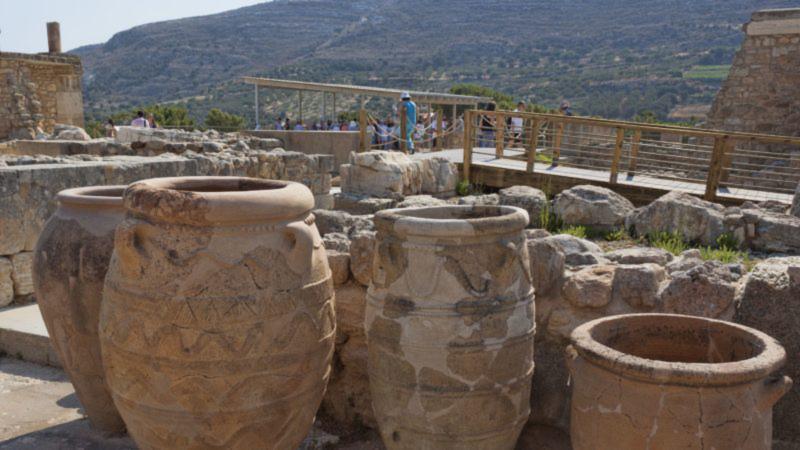
Nevertheless, Cousteau’s mention of ancient Greece was of particular interest. As he told euractive.gr: “During my last visit to Santorini, I visited the archaeological site in Akrotiri. I was impressed by the way the Ancient Greeks stored in their jars the olive oil and the wine. I think we can take lessons from this’’.
But what are these lessons can we take from Ancient Greece?
The answer may be surprising but interesting, according to Cousteau: “the problem we are facing today is something that has been the main concern of all the great civilisations in the past: the production, storage and shipping of goods. During the last century, the way we chose to do it was not sustainable”.
With regard to the future, ‘’I’m not optimistic, but I think we still have a chance if people change their behaviour” he said.
The UN’s representative for the environment in Brussels, Ulf Björnholm, proposed the following: “we need regulations, economic incentives and voluntary action. It is also necessary to promote the circular economy’’, he said while stressing that ‘’we should reduce the production of both disposable and non-recycled plastics, for example in cosmetics and cars’’.
On 6-7 December, the UN is organizing a world conference entitled ‘’Towards a pollution-free planet’’, while an information campaign has already been launched, inviting governments, companies and civil society to take part in the initiative and take local action.
Source: euractiv.com
Ask me anything
Explore related questions