


×
GreekEnglish

×
  • Politics
  • Diaspora
  • World
  • Lifestyle
  • Travel
  • Culture
  • Sports
  • Cooking
Tuesday
27
Jan 2026
weather symbol
Athens 9°C
  • Home
  • Politics
  • Economy
  • World
  • Diaspora
  • Lifestyle
  • Travel
  • Culture
  • Sports
  • Mediterranean Cooking
  • Weather
Contact follow Protothema:
Powered by Cloudevo
> Culture

The insane grammar rule non-English speakers won’t have heard of

Apparently, a lot of English grammar rules only come as a surprise to those who know them most intimately

Newsroom November 9 07:02

English grammar, beloved by sticklers, is also feared by non-native speakers. Many of its idiosyncrasies can turn into traps even for the most confident users.

But some of the most binding rules in English are things that native speakers know but don’t know they know, even though they use them every day. When someone points one out, it’s like a magical little shock.

This week, for example, the BBC’s Matthew Anderson pointed out a “rule” about the order in which adjectives have to be put in front of a noun. Judging by the number of retweets—over 47,000 at last count—this came as a complete surprise to many people who thought they knew all about English:

Things native English speakers know, but don’t know we know: pic.twitter.com/Ex0Ui9oBSL

— Matthew Anderson (@MattAndersonNYT) September 3, 2016

That quote comes from a book called The Elements of Eloquence: How to Turn the Perfect English Phrase. Adjectives, writes the author, professional stickler Mark Forsyth, “absolutely have to be in this order:

opinion-size-age-shape-colour-origin-material-purpose Noun

So you can have a lovely little old rectangular green French silver whittling knife. But if you mess with that order in the slightest you’ll sound like a maniac.”

Mixing up the above phrase does, as Forsyth writes, feel inexplicably wrong (a rectangular silver French old little lovely whittling green knife…), though nobody can say why. It’s almost like secret knowledge we all share.

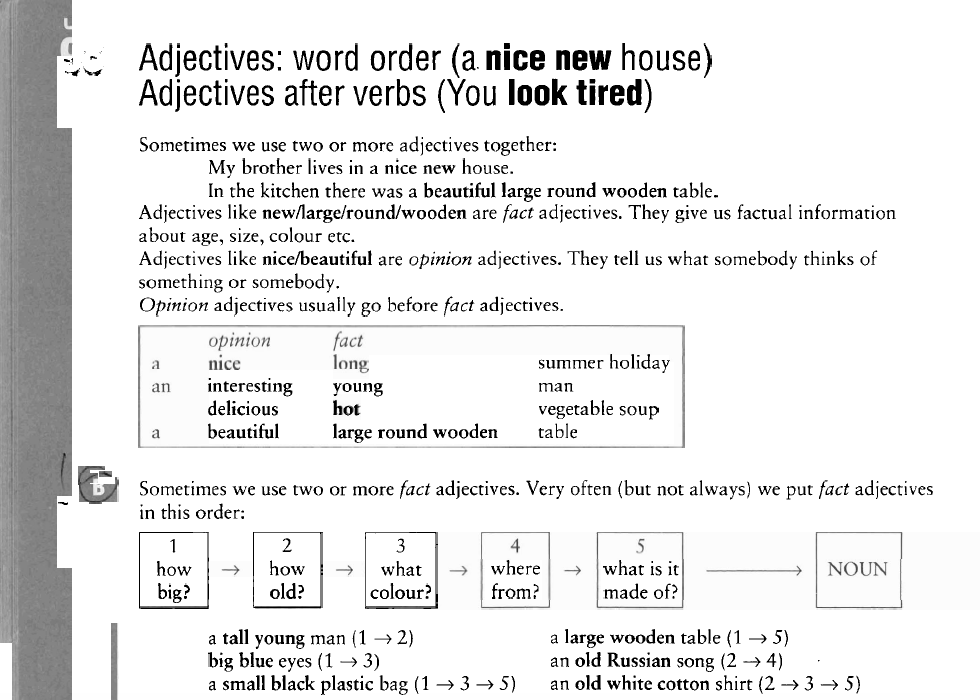
Learn the language in a non-English-speaking country, however, and such “secrets” are taught in meticulous detail. Here’s a page from a book, published by Cambridge University Press, used regularly to teach English to non-native speakers. An English teacher in Hungary sent it to us.
ss

The book lays out the adjective order in the same way as Forsyth’s surprising illumination. Hungarian students, and no doubt those in many other countries, slave over the rule, committing it to memory and thinking through the order when called upon to describe something using more than one adjective.

>Related articles

Ioulia Karapataki to headline Antipodes & Greek Fest at Darling Harbour

The Shackled Men of Phaleron: This is what the space that will host the major archaeological find will look like – Photos

The dirty side of Pompeii: baths filled with sweat and urine, according to a new study

The fact is, a lot of English grammar rules only come as a surprise to those who know them most intimately.

Learning rules doesn’t always work, however. Forsyth also takes issue with the rules we think we know, but which don’t actually hold true. In a lecture about grammar, he dismantles the commonly held English spelling mantra “I before E except after C.” It’s used to help people remember how to spell words like “piece,” but, Forsyth says, there are only 44 words that follow the rule, and 923 that don’t. His prime examples? “Their,” “being,” and “eight.”

Source: qz.com

Ask me anything

Explore related questions

#country#culture#detail#English#foreign#language#native#rules
> More Culture

Follow en.protothema.gr on Google News and be the first to know all the news

See all the latest News from Greece and the World, the moment they happen, at en.protothema.gr

> Latest Stories

Properties without a “premium”: The two taxes that stay out of the game and who benefits

January 27, 2026

Weather: Red code for severe phenomena today in Crete, two more waves of severe weather to follow

January 27, 2026

Tragedy in Trikala: Even steel melted in the fire at the Violanta factory – The unanswered questions

January 27, 2026

UN welcomes the return of the body of the last Hamas hostage, calls for full implementation of the ceasefire

January 27, 2026

Former Home Secretary in the Shunak government joins Farage’s party

January 27, 2026

40-year-old Nigerian man murdered 23-year-old ex-partner in Britain for breaking up with him

January 27, 2026

Ioulia Karapataki to headline Antipodes & Greek Fest at Darling Harbour

January 26, 2026

Trump Doctrine “with me or out in the cold”: Europe in a difficult position, called to make critical decisions

January 26, 2026
All News

> Politics

Stop to the ecological crime in Milos: Construction halted, Transparency Authority intervenes under Papastavrou’s orders

Three actions by the Minister of Environment aim to put a stop to the construction works for the expansion of the White Coast in Mytakas, Milos

January 26, 2026

Karystianou’s premiere on Greek-Turkish relations: “Tell us the agenda of your meeting with Erdogan so citizens can judge whether it should take place!”

January 26, 2026

Florides: The Paraskevopoulos law released murderers, robbers, rapists, drug dealers and 80% returned to serious crime

January 26, 2026

Mitsotakis to Cabinet: I propose a special three-seat constituency for Greeks abroad

January 26, 2026

Mitsotakis: Europe must remain united and maintain channels of cooperation with the US, even in times of tension – We seek an active role in Gaza

January 25, 2026
Homepage
PERSONAL DATA PROTECTION POLICY COOKIES POLICY TERM OF USE
Powered by Cloudevo
Copyright © 2026 Πρώτο Θέμα