





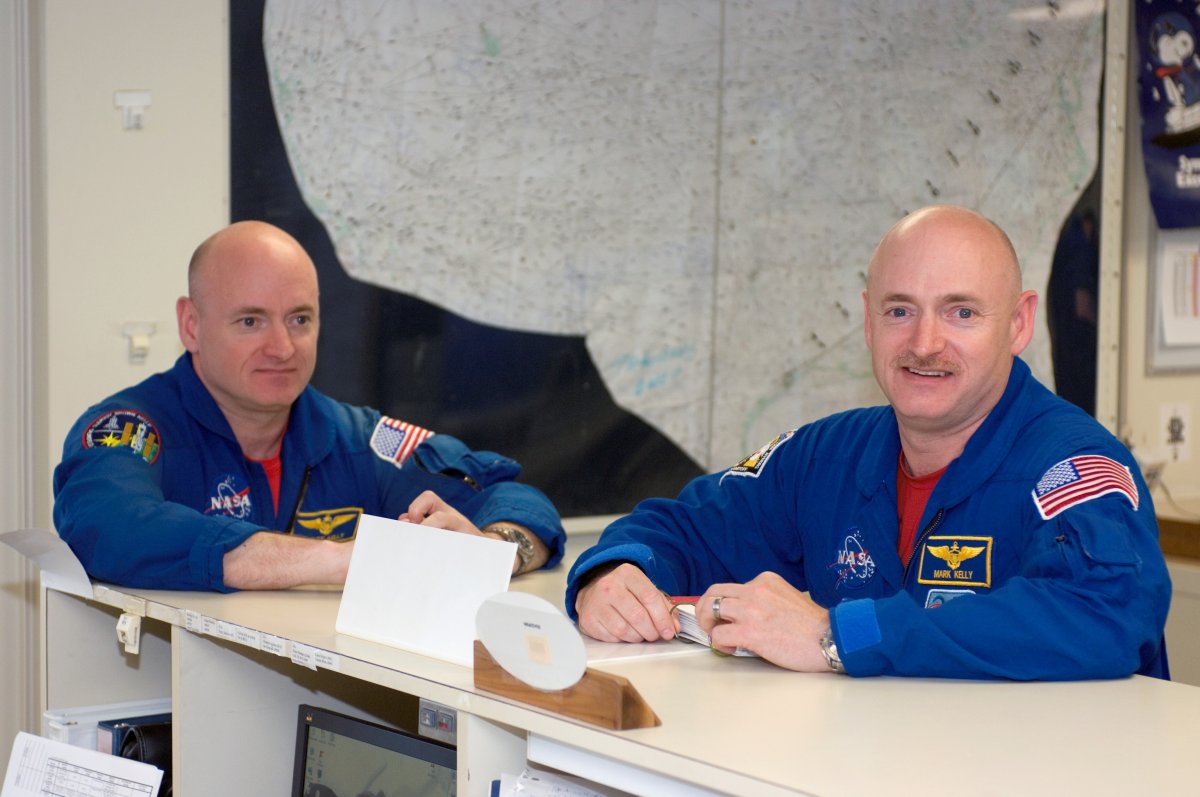
Last March, NASA astronaut Scott Kelly returned to Earth after spending nearly one year in space. During his 340 days aboard the International Space Station, or ISS, scientists were also observing Scott’s identical twin brother, Mark Kelly, while he hung out on Earth.
Because Scott and Mark have the same DNA, scientists have had the rare opportunity to take a closer look at the changes in the human body that might be connected to spaceflight by comparing changes in Scott’s genes with changes in Mark’s over the same time period.
Scientists already know that living in a weightless environment for six months or less can have negative effects on the human body, like stretching your spine, shrinking your muscles, or messing up your sleep cycle. But the effects of long-term exposure to space are less well-known. The results from NASA’s Twin Study, which were first released at the end of January, can be used to prepare for future deep-space missions.
Researchers took biological samples from each twin before, during, and after Scott’s space mission, and they are still combing through the data. It might be some time before the full results of the Twin Study are published due to the amount and the sensitivity of the information, some of which the twins may want to keep private, according to Nature.
Some of the most interesting results so far
– Scott’s telomeres got longer, then shrunk back to normal. Scott’s telomeres, or the caps at the end of chromosomes, became longer than his brother’s while he was in space, but quickly returned to their normal length once he returned home.”That is exactly the opposite of what we thought,” Susan Bailey, a radiation biologist at Colorado State University in Fort Collins, told Nature. That’s because shorter telomeres are generally associated with getting older. Scientists are still studying what this means, but it could be linked to more exercise and eating fewer calories while in space, according to NASA.
– Scott’s methylation levels decreased. The level of methylation, a process that can change the activity of a DNA segment without changing its sequence, decreased in Scott’s white blood cells during flight and increased in Mark half-way through the study. “These results could indicate genes that are more sensitive to a changing environment whether on Earth or in space,” according to NASA.
– The twins hosted different gut bacteria. Scott and Mark hosted different gut bacteria, or the “bugs” that aid in digestion, throughout the year-long study. This was probably a result of their different diets and environments, NASA writes.
– Scientists are looking for what they’re calling a “space gene.” By sequencing the RNA in the twins’ white blood cells, researchers found more than 200,000 RNA molecules that were expressed differently between the brothers. It is normal for twins to have unique mutations in their genome, but scientists are “looking closer to see if a ‘space gene’ could have been activated while Scott was in space,” according to NASA.
Ask me anything
Explore related questions