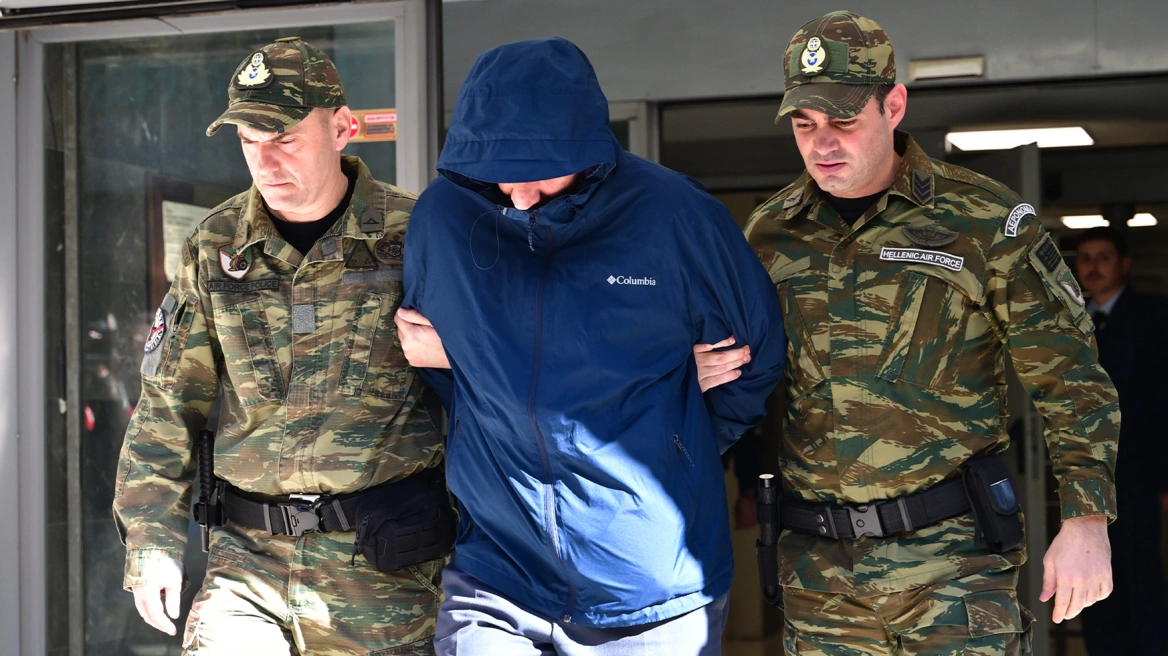





The 54-year-old Air Force colonel accused of espionage on behalf of China has been placed on suspension following his transfer to the Air Court on Friday morning. The defendant was granted time to submit his testimony next Tuesday and remains under detention.
This development constitutes the immediate application of the law on the New Structure of the Armed Forces, which was the first bill passed for 2026. Article 102 explicitly provides that the Chief of the Hellenic National Defence General Staff (GEETHA) may place a permanent officer or non-commissioned officer on suspension when criminal prosecution is initiated against them for any felony or for specific offenses outlined in the Military Penal Code.
Article 102 directly applies to the case of the 54-year-old colonel accused of espionage, as felony charges have been brought against him under Article 144 of the Military Penal Code (Law 2287/1995), which concerns the “Transmission of Military Secrets.” He now faces a potential prison sentence of up to 20 years, while receiving only partial pay during his suspension.
For at least 18 months, the commander of the 128th Air Base in Kavouri had allegedly established a communication channel with China, funneling information of vital and national importance to Beijing—demonstrating, according to sources, China’s successful penetration into Europe.
Those who knew him describe him as a highly intelligent Air Force officer whose actions opened a back door to sensitive Armed Forces information. A trip he had taken to China is now under close scrutiny by the National Intelligence Service (EYP) and other competent authorities.
How He “Broke” and Confessed to Intelligence Officers
The 54-year-old colonel, who was not a pilot but specialized in Telecommunications and Electronics, played a critical role in what now determines modern warfare: information.
He had in-depth knowledge of the telecommunications spectrum, including communications systems, frequencies, and radar operations. Modern warfare is conducted across five domains—land, air, sea, cyberspace, and space—and the common denominator in all of them is information. This advantage, investigators say, is what the colonel provided to China.
The EYP, in cooperation with foreign intelligence services including the CIA, had placed the officer under surveillance at least since last October, initially seeking to confirm intelligence indicating he was acting as a Chinese spy and to identify the information he was transmitting to Beijing.
Unfortunately, the first suspicion was quickly confirmed. Investigators determined that the colonel had been photographing documents and sensitive material and transmitting them to China using an encrypted device provided by his handlers.
During Thursday morning’s operation at the air base where he served as commander, authorities seized computers, mobile phones, hard drives, and USB devices, all of which are being sent for forensic analysis. A simultaneous search of his residence uncovered a laptop, and the specialized encrypted communication device was also located.
During interrogation, after initially giving contradictory statements, the colonel ultimately confessed fully to two EYP officers. He provided detailed information about his handler—his direct contact—who is based in China. As a result, Greek authorities now know who received the classified information.
Of particular interest is the fact that the colonel appears to have been initially approached by Chinese operatives through a message sent via an online application, marking the beginning of his recruitment process.
It has also been established that he traveled to China in recent months, with Greek intelligence services now working to complete the puzzle of this espionage thriller. Investigators are also examining whether any accomplices were involved. So far, no evidence has emerged implicating others, although officials stress that “the investigation has only just begun.”
Ask me anything
Explore related questions