





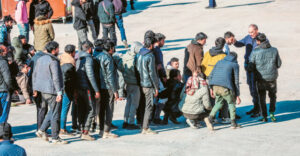
At a time when Crete received 4,000–4,500 illegal migrants in December, highlighting the pressure that continues to be exerted on specific entry points, the Ministry of Migration and Asylum and the competent minister, Thanos Plevris, are introducing a bill that changes the rules of the game. With interventions that cut privileges which acted as a magnet for the entry of young foreign nationals, provide for release from prison for minor offenses on the condition of immediate deportation, and tighten the framework for illegal migration, the government is attempting to capitalize on a 21% reduction in total arrivals compared to 2024 and move into a new phase of law enforcement.
The timing is not accidental. In December, Crete relived memories of the summer, with boatloads from Libya arriving one after another and suffocating the system. Since then, much has changed. The tightening of the framework with the suspension of the examination of asylum applications for three months sent a clear message and flows dropped sharply, while the island is now better prepared to manage the situation. This is also shown by the state’s response to the December incidents, which admittedly were increased. Migrants were taken in by the Hellenic Coast Guard, initially transferred to Agia in Chania, to a site used for the temporary management of emergency situations, and then distributed to facilities across the country.
Despite this episodic wave, overall figures paint a different picture for the year. In 2025, arrivals in the country amounted to 48,068, compared to 60,886 in 2024 — that is, 13,000 fewer migrants and a reduction of around 21%. According to government sources, this result is directly linked to the tightening measures taken in the summer, following the sharp increase in flows from Libya.
Unaccompanied minors
Until now, a foreign national entering the country as an unaccompanied minor could receive a residence permit of up to 10 years, provided they attended three grades of a Greek school up to the age of 23.
This provision led to a recurring phenomenon: 17-year-olds entering illegally, being registered as minors, enrolling in school structures, and until they turned 23 being neither deportable nor stripped of their protection status, while at the same time acquiring the possibility of a multi-year residence permit.
The new bill completely abolishes this possibility. Unaccompanied 17-year-olds are now treated as adults, without special privileges, cutting — as competent sources characteristically note — “the magnet at its root.” An indicative case, according to the ministry, was that of the two Egyptians accused of attempting to rape a 13-year-old, who had entered under this status.
In the same spirit, semi-independent living programs are also abolished. Unaccompanied minors will no longer be housed in apartments, as was the case until now, but exclusively in facilities, so that any preferential treatment encouraging circumvention of the framework ceases.
These changes are directly linked to the ministerial decision on age verification through medical examinations, which showed — according to initial data — that the majority of those declared as minors are in fact adults.
Deportation instead of imprisonment
A third critical pillar of the bill, in cooperation with the Ministry of Justice, concerns foreign nationals convicted of misdemeanors. Under the new regulation, those serving prison sentences for minor offenses will be released on condition of deportation.
In practice, this means that thousands of imprisoned foreign nationals convicted of minor offenses will not remain in Greek prisons but will be led directly into removal procedures, easing pressure on the correctional system and reinforcing the message of zero tolerance.
NGOs and gray zones
A significant chapter of the bill concerns Non-Governmental Organizations and their role in migration. The ministry is proceeding, on the one hand, with simplifying registration in the NGO Registry so that it does not function as a “closed club” of specific organizations, but on the other hand it is introducing particularly strict sanctions.
Specifically, NGO members who participate in the smuggling of illegal migrants will now face prison sentences from 10 years up to life imprisonment, unlike the previous regime, under which similar offenses could be classified as misdemeanors. At the same time, NGOs will be struck off the Registry if the involvement of their members in such acts is proven.
At the same time, the possibility of preferential programmatic agreements between the ministry and NGOs is abolished. From now on, any contract will be concluded exclusively through competitive tender procedures, exactly as applies to private companies.
20,000 refugees
The bill is not limited to preventing illegal migration. For those who are granted asylum, a new model of integration through work is being introduced. This is an important provision, since its implementation makes it possible to utilize the approximately 20,000 refugees who each year obtain international protection status in Greece.
Beneficiaries will be transferred to facilities where there are real needs — agricultural areas, industry, construction — and will be informed that their only possibility of remaining is work, not long-term dependence on benefits.
In this direction, Koutsochero is already operating, where more than 1,000 asylum beneficiaries are being trained in agricultural work, in a model that the ministry intends to expand.
Ask me anything
Explore related questions
