





NASA has published a spectacular new map of the universe, which could help scientists solve some long-standing mysteries of the cosmos.
More specifically, as reported by jpl.nasa.gov, the first mapping of the entire sky was carried out with the help of NASA’s “SPHEREx” space telescope and simulates the instrument’s three-dimensional view of the sky, including charred red cosmic dust, electric blue hydrogen, and white, blue, and green stars.
The panoramic image depicts these and dozens of other colors using the telescope’s ability to see wavelengths of infrared light, which are invisible to the human eye.
The colors allow astronomers to measure the distance from the telescope to hundreds of millions of galaxies, with the three-dimensional image of the map measuring how the recorded galaxies are distributed throughout the universe.
The reddest galaxies are farther away, while the closer ones appear blue, as light is stretched or compressed in a phenomenon known as “redshift.”
Scientists will use these data, collected since the telescope’s launch into low Earth orbit in March, to study how galaxies have changed over the nearly 14 billion years of the universe’s history and potentially learn more about how the basic ingredients of life were created in our galaxy, the Milky Way.
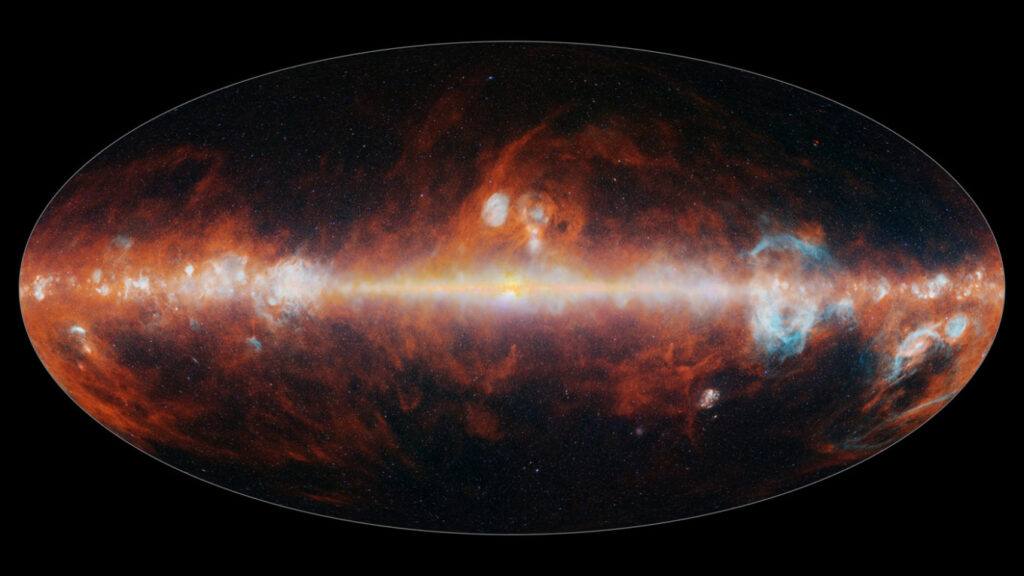
“Although they are not visible to the human eye, these 102 wavelengths of infrared light are widespread in the universe, and observing the entire sky in this way allows scientists to answer big questions.
Including how a dramatic event that occurred in the first billionth of a trillionth of a billionth of a second after the Big Bang affected the three-dimensional distribution of hundreds of millions of galaxies in our universe,” NASA explained.
The SPHEREx space telescope
Although the James Webb Space Telescope can also see in infrared light, its field of view is thousands of times smaller compared to SPHEREx.
To date, no mission has mapped the entire sky in as many colors as SPHEREx.
The SPHEREx telescope—known as the “Spectro-Photometer for the History of the Universe, the Epoch of Reionization, and Ices Explorer”—is currently in orbit about 400 miles above Earth.
It orbits Earth about 14.5 times per day, taking approximately 3,600 images along a circular strip of the sky and continuously shifting to capture the entire sky in 360 degrees.
It will complete three more full-sky scans during its two-year mission, collecting data on more than 450 million galaxies and more than 100 million stars in our Milky Way.
How SPHEREx works
SPHEREx uses six detectors, each paired with a specially designed filter that contains a scale of 17 colors. This means that every image taken with these six detectors contains 102 colors.
This also means that every full-sky map produced by SPHEREx is actually 102 maps, each in a different color.
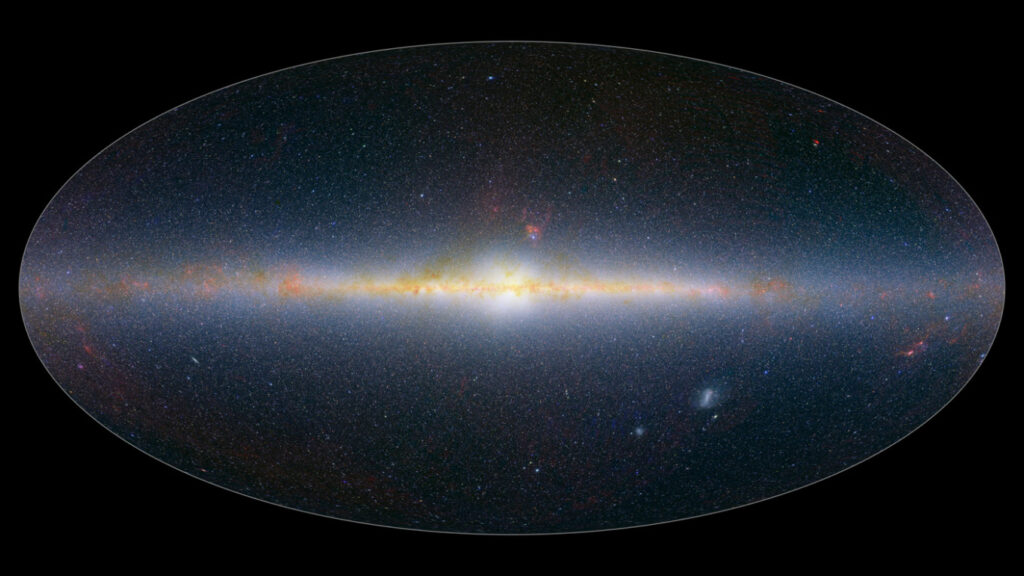
The observatory will use these colors to measure the distances to hundreds of millions of galaxies. Although the positions of most of these galaxies have already been mapped in two dimensions by other observatories, the SPHEREx map will be three-dimensional, allowing scientists to measure subtle differences in how galaxies cluster and are distributed throughout the universe.
The SPHEREx mission is managed by NASA’s Jet Propulsion Laboratory (JPL) at the California Institute of Technology.
The telescope and the spacecraft were built by BAE Systems. The scientific analysis of SPHEREx data is carried out by a team of scientists at 10 institutions in the United States, South Korea, and Taiwan.
The total cost of the SPHEREx mission—including development, construction, launch, and operation of the space telescope—is estimated at approximately USD 488 million.
The data are processed and archived at IPAC at Caltech in Pasadena, which is managed by JPL for NASA. The mission’s principal investigator is based at Caltech with a joint appointment at JPL. The SPHEREx data set is publicly available.
“SPHEREx is a medium-class astrophysics mission that delivers big science. It is a phenomenal example of how we turn bold ideas into reality and, in doing so, unlock enormous potential for discoveries,” said Dave Gallagher, director of NASA’s Jet Propulsion Laboratory.
Ask me anything
Explore related questions


