




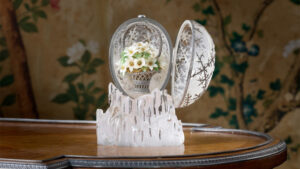
All the icy brilliance of the Russian winter is captured by the House of Fabergé in this imperial egg, which is going under the hammer in London on 2 December. It is so realistic one might think it will start melting at any moment: the egg rests on a base resembling a shard of ice — “as if freshly retrieved from the frozen Neva,” as Christie’s describes it — decorated with tiny silver rivulets. Its glossy surface shimmers with “crystalline” veins of frost, giving the impression that it is truly frozen, while beneath the transparent shell a pale white form can be faintly seen.
The story behind the imperial Fabergé egg with 4,000 diamonds
The egg opens like a locket to reveal a small basket of woodland anemones, carved from white quartz — the first wildflowers to bloom when the snow recedes, a sign that the long, frozen night of the Russian winter is ending and spring is approaching. It was presented by Emperor Nicholas II to the Dowager Empress Maria Feodorovna on Easter Sunday in 1913, and is considered one of the most luxurious and imaginative of the 50 imperial eggs created by the House.
Imperial Fabergé eggs
Within the Romanov family, the tradition of offering Fabergé eggs was established by Emperor Alexander III in 1885, when he gave one each year to his wife, Maria Feodorovna. After his death, Nicholas II continued the tradition, gifting eggs both to his mother and to his wife, Alexandra.
For Carl Fabergé and his goldsmiths, the commission of the imperial Easter eggs was an honour but also extremely demanding. Work on the following year’s eggs began immediately after delivery of the current ones, as two new original ideas had to be devised each time. The emperor was never informed in advance — he himself enjoyed being surprised — and the eggs were presented during Holy Week. The days before delivery were filled with anxiety. “Everyone worried that something unforeseen might happen at the last moment,” wrote chief designer Franz Birbaum.
A remarkable departure from tradition
The Winter Egg of 1913 was extraordinarily delicate and was designed by a young artist from a family of Finnish jewellers, Alma Pihl. Many members of her family worked for Fabergé in St Petersburg and Moscow; at the age of 20, she too began working at the firm, painting life-size watercolours of the creations for the archive. In her spare time she designed jewellery, and her uncle, craftsman Albert Holmström, recognised her talent and brought her into his workshop. Some of her designs went into production and were sold as Fabergé jewellery. When, a few years later, Holmström constructed the Winter Egg, he was working from his niece’s design.
Most imperial eggs draw inspiration from art history — Rococo, Baroque, Neoclassicism — and feature miniatures with portraits of the imperial family, landscapes of palaces or small replicas of statues. The Winter Egg, by contrast, draws inspiration from the simplicity of nature, from the abstract shapes of frost on a frozen windowpane — likely an idea conceived by Pihl on a quiet, freezing morning in the workshop.
Equally striking is the choice of materials: the transparent quartz of the base and shell is not the most luxurious material, yet thanks to the craftsmanship of the House it convincingly conveys both ice and glass, transforming a simple mineral into a precious work of art. The “meltwater” at the base is platinum, while the overall brilliance comes from the careful setting of more than 4,000 diamonds. The “surprise” inside is also a separate work of art and a triumph of botanical imitation: the anemones are loosely arranged in a woven basket of platinum and pink diamonds. Some blooms are open, others half-closed. The petals are carved from white quartz, the stamens from green demantoid, and the leaves from pale green jade.
The Dowager Empress kept her gift for less than four years. After Nicholas’s abdication in 1917, most of the eggs were transferred to the Kremlin Armoury by the provisional government. Following the October Revolution, the Winter Egg passed into the hands of the Bolsheviks and, like many other objects, was sold by the new Soviet regime to “capitalists” when the state desperately needed foreign currency. It ended up in the possession of an English collector and later changed hands several times before being auctioned by Christie’s in Geneva in 1994 and in New York in 2002, fetching $9,579,500 — on both occasions setting a world record for a Fabergé work.
In total, 50 imperial Easter eggs were produced, of which 43 survive. This particular egg, symbolising renewal and resurrection, carries special significance: 1913, the year it was gifted, marked the 300th anniversary of the Romanov dynasty — and the last peaceful year of the Russian Empire. The following year war broke out, followed by revolution and civil war, and the murder of Nicholas, his wife and their children in Siberia.
The Winter Egg is on display from 27 November to 2 December 2025 at Christie’s in London.
Photos: Courtesy of Christie’s – www.christies.com
Ask me anything
Explore related questions