





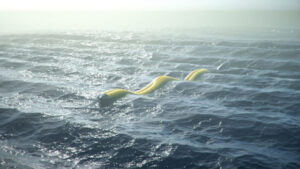
Could a “snake” provide clean energy production? The answer is yes, if it’s about the Anaconda Lobe-Tendon, an innovative and pioneering proposal in the field of wave energy.
The Anaconda is a truly new approach to harnessing wave energy.
Specifically, it is a sealed, water-filled rubber tube anchored to the seabed. The device uses the bulge wave phenomenon. Ocean waves traveling along the tube excite bulge waves inside it. When the speed of the ocean waves is close to that of the internal bulge waves, the bulge wave “surfs” ahead of the ocean wave, resulting in a resonant energy transfer.
More precisely, the outer tube is made of reinforced natural rubber, a material chosen for its strength, flexibility, and durability in harsh marine environments. The internal tendons are made of high-performance natural rubber. As ocean waves travel along the flexible tube, they create pressure bulges within the structure. These bulges move toward a power take-off system at the end of the tube, where their energy is converted into clean electrical power. The speed of the internal bulge waves can be matched to that of the ocean waves to maximize energy production.
The device can be built in various lengths to suit the climate and conditions of each region and can operate either individually or as an array of units. The goal is for the Anaconda Lobe-Tendon to one day supply energy to island communities, offshore facilities, and the power grid.
The grant
It was developed by Checkmate Flexible Engineering, which recently secured a £750,000 grant from the UK’s national innovation agency, Innovate UK, to accelerate its development.
The 18-month project, known as Môr Neidr (“sea snake” in Welsh), will help position Southwest Wales as a hub for marine renewable energy.
In collaboration with partners such as Swansea University, CGEN Engineering, Offshore Renewable Energy (ORE) Catapult, and Wave Venture, the project will provide new materials, testing, and research infrastructure in the region. The work will advance the technological readiness and performance of the Lobe-Tendon Anaconda and pave the way for future sea trials.
Paul Auston, Director of Checkmate Flexible Engineering, stated: “This grant allows us to accelerate the development of the Anaconda and build upon the innovation already delivered by our team, with a clear path toward future sea trials. It’s an exciting step forward not only for Checkmate but for the future of wave energy in Wales, where we see tremendous potential to deliver clean, predictable energy on a commercial scale.”
As noted, unlike many wave energy technologies that consist of large, costly, rigid structures, the flexible design of the Anaconda Lobe-Tendon uses less material per unit of power. This not only reduces cost but also leverages the natural compliance and proven durability of rubber in harsh marine environments.
Through ongoing research, the company has achieved significant improvements, reducing the material required by more than 70% and mitigating key identified risks while maintaining performance characteristics.
16 years of research
The Anaconda Lobe-Tendon is not a fleeting idea but the result of a 16-year journey.
The Anaconda technology was invented by Rod Rainey, an expert in floating offshore structures, and the late Professor Francis Farley, who worked on wave energy for 35 years. Checkmate Sea Energy acquired all rights and patents for the technology in 2007 to continue research and development until the project reached commercial scale.
In 2009, the Anaconda WEC received support from the Carbon Trust. Their independent analysis stated that it “has the potential to deliver groundbreaking reductions in the cost of wave energy.” The Anaconda underwent multiple wave tank tests at various scales to determine power output, fatigue, performance, and scalability. The tests showed impressive energy production and a lifespan exceeding 12 years.
In 2015, after initial successful trials, the Anaconda WEC was selected for funding by Wave Energy Scotland’s Novel Wave Energy Converter program. The funding advanced the technology’s development and cost optimization. In 2019, however, Wave Energy Scotland ceased funding for the Anaconda WEC, limiting plans for a quarter-scale ocean test. This decision led the Checkmate Sea Energy team to review the previous 13 years of work to redesign the technology.
During this technical review, the design was modified to create a lower-cost and more scalable WEC through the invention of the patented Lobe-Tendon technology, conceived by Mark Prentice.
Tests by Wave Venture confirmed the benefits of the Lobe-Tendon technology, which has been shown to reduce the required tube material by more than 70%. Simultaneous analysis and physical model testing have demonstrated increases in power capture. These advances bring the Anaconda Lobe-Tendon much closer to commercial viability.
To date, the device’s development has been funded through private capital, but to take the next major step—a full ocean trial—significant funding will be required.
At the same time, however, there is a clear market. Today, most of the more than 11,000 inhabited islands around the world rely on diesel-generated electricity, while Anaconda devices could provide them with renewable energy.
Perhaps this “snake” truly represents a glimpse of the not-so-distant future.
Ask me anything
Explore related questions