





Drones over Poland, Russian MiG fighters crossing Estonian airspace, undersea telecom cables damaged deep beneath Valtica, airports paralyzed by cyber attacks and flying objects, mysterious explosions and assassinations, swarms of bots aiming to disrupt elections: none of these incidents are in themselves a casus belli, but together they add up to something new and dangerous.
They constitute a new and dangerous thing, but they are a new and dangerous thing.
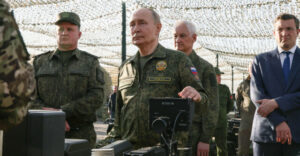
Vladimir Putin is waging a “grey zone” campaign against NATO: a cheap, denialist, and well-measured effort aimed at rattling Europe, which has – so far – avoided open conflict. “We are not at war, Germany’s chancellor,Friedrich Murch said this week. “But we are not at peace either.”
No serious damage was caused in any of these cases, so what were they for? According to the Economist, Putin knows he cannot defeat NATO in an open confrontation, yet his purpose, based on his wide range of writings and speeches, is more than just being… a nuisance. He is trying to accomplish three things.
Putin’s three goals
First, the Russian president seeks to break NATO unity. His aim is to make Europeans doubt each other and, in particular, to question the US commitment to the alliance it founded in 1949. He wants to “plant” the suspicion that Article 5 – which holds that an attack on one member is an attack on all – cannot be sustained; and, ultimately, to drive America away from Europe altogether.
And Donald Trump’s reaction to the drone invasion of Poland, saying that “it could have been a mistake, even though it required a show of solidarity; it threw water on the Russian mill. If sabotage and airspace violations are relegated to – almost – routine, deterrence becomes a topic of discussion – and once it becomes a topic of discussion, it is weakened.
Putin’s second target is Ukraine. His summer offensive failed, so he wants to increase the cost to European countries that support the Ukrainian military. So he emphasizes grey zone attacks on the countries that are its strongest supporters: Poland, Estonia and Denmark suffered drone attacks, GPS jamming and sabotage. Germany experienced cyber attacks on defense and logistics companies. Moldova and Romania, as frontline countries, faced interference in their elections – in both cases unsuccessful, showing that the Russian president does not always achieve his goal. His message to voters and politicians is simple: instead of sending weapons to Ukraine, focus on normalization with Russia or self-defense.
The third reason for this campaign is deeper and older. Putin hates classical liberal democracies, whose wealth and resilience highlight his failures and oppression at home. They outspend him economically. Russia’s GDP is smaller than Italy’s even though its population is many times larger. The more he can sow discord and confusion in the West, the more powerful he appears.
How the Allies should react
What should the allies do in response to him? First, they should disclose everything. The temptation is to ignore minor provocations or, lacking proof of Russian responsibility, to stick to accusations alone. But to ignore the grey zone is to concede it. And once you concede it, it grows. Sabotage, cyber attacks, election interference: each must be attributed and made public quickly, with evidence. This deprives Russia of the plausible deniability and educates Western voters that they are the target of this type of campaign.
NATO and the European Union also need to improve their resilience. Gray zone defense includes spare parts and repair teams for cables and pipes, rapid cyber response teams, and enhanced election commissions. It’s the tedious but vital work of building surplus capabilities and staying ready. At the same time, Europeans also need to harden their defences. Patrols in the Baltic must be constant. Europe needs cheap interceptors that can neutralize the low-end drones that Russia is building by the tens of thousands. Taking down F-35s and using missiles that cost millions against drones that cost only thousands will eventually exhaust Europe’s defenses, making it vulnerable.
Finally, the Alliance needs to be specific about the costs of “hostile” actions. Drones over borders should draw sanctions on suppliers and overseas umbrella companies. Cyber attacks must be met with cyber countermeasures. The situation that has developed proves that the time has come for the “frozen” Russian assets to be used to cover Ukraine’s defense, which is in fact Europe’s defense. And that defense can mean shooting down a warplane that threatens human lives or property.
If Russia convinces itself that it can get away with it without much consequence, something really dangerous may one day happen – such as Putin “grabbing” a piece of land around Narva on the Estonian side of the border, a town full of Russian speakers whose rights Russia appears to be defending.
Ask me anything
Explore related questions