




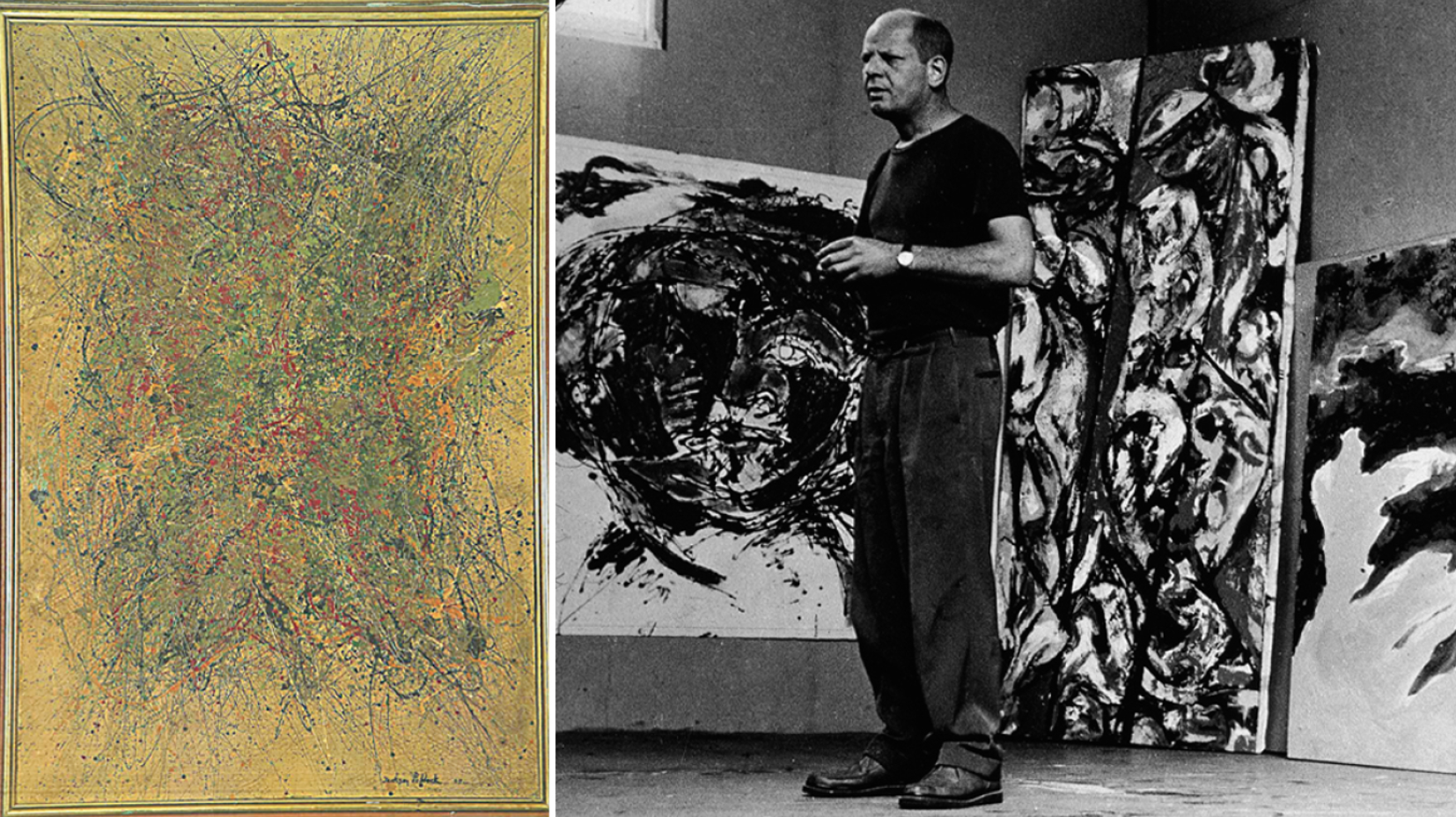
A gripping, long-running mystery has been unfolding for the past two years, centered around a Greek businessman who claims to be an art dealer and collector.
On February 18, 2023, this individual was arrested in Sofia inside the home of a Bulgarian businessman while attempting to sell a painting worth €12 million, attributed to the famous American painter Jackson Pollock, a pioneer of abstract expressionism. He claims to have inherited the painting from his Romanian grandfather on his mother’s side.
The arrest of the art dealer was carried out in cooperation with the Bulgarian authorities and the Greek Organized Crime Unit of Crete, which was investigating the involvement of a man from Rethymno in a forgery ring. However, the dealer was released just hours later, with no charges filed against him.
Jackson Pollock had passed away 67 years before the operation in Sofia, prompting the Bulgarian authorities to seize the painting to determine its authenticity. No conclusive results have been reached yet, but Pollock’s famous “drip technique,” through which he created his signature fluid paintings, is considered almost impossible to replicate.
Despite the release of the dealer, the Greek police continued their investigation. Officers from the Organized Crime Unit in Crete raided the dealer’s four properties in Athens, including his parents’ home, confiscating multiple paintings.
On November 30, 2023, reports surfaced in the media regarding the confiscated artworks, highlighting what was portrayed as a major police success. These reports caused financial damage to the dealer, as his clients became aware that he was under investigation for allegedly being part of a forgery ring.
At that time, prominent lawyer Vasilis Kapernaros, who represents the art dealer, described the case as a “phantom indictment,” emphasizing that his client had never been summoned for questioning as a suspect.
A legal battle has since erupted between the criminal lawyer and the head of the Organized Crime Unit in Crete, with lawsuits filed from both sides.
In his lawsuit against the police chief, Kapernaros described the disputed Pollock painting as being created in 1949, an oil painting on canvas measuring 190×130 cm, with an estimated value of €12 million. The collector, an experienced dealer in international art transactions, had prepared all necessary documents to ensure the legality of the sale.
However, a phone call allegedly changed everything. According to the lawsuit, while the final details of the transaction were being settled, Greek authorities intervened by providing Bulgarian officials with false information, claiming the painting was stolen.
The collector and his associate were arrested in Bulgaria, while police seized the painting and its accompanying documentation. The allegations from the Greek authorities were serious, but, as the lawyer claims, were not backed by any concrete evidence, leading to the dealer’s release. Despite this, the artwork remained confiscated, raising concerns about its ultimate fate.
The mystery did not end there. The next day, a team of police officers raided four residences belonging to the art dealer in Athens, including his family home. The lawyer’s lawsuit described the operation as resembling a cinematic raid, with officers arriving unannounced, failing to present a search warrant, refusing to identify themselves, and seizing twelve artworks without issuing a formal inventory list.
The confiscated pieces were taken from the collector’s parents’ home in Kolonaki, his father’s house in Galatsi, and a rented storage unit in the same area. Later, police conducted a raid at the dealer’s residence in Saronida, in the presence of his father, but reportedly found nothing.
The dealer’s parents were in shock, as the police officers who stormed their home alleged that their son had been arrested in Sofia for attempting to sell a stolen artwork. The key question remains: who ordered such an aggressive intervention?
One of the most perplexing aspects of the case involves the media leak of the investigation files. According to the lawsuit, while neither the collector nor his legal representatives had been formally informed about the case, details and images of the confiscated paintings were leaked to journalists and broadcast on television.
Media reports framed the operation as a major success for Greek authorities. However, according to Kapernaros, the reality was quite different. No formal proceedings had been initiated against his client, and the only evidence against him consisted of allegations made by two investigating officers.
Further complicating the situation, the deputy chief of the Organized Crime Unit allegedly sent an email to international art houses introducing himself as a “Police Captain” of the Greek Police. The email reportedly warned that the collector was dealing in forged artworks.
Kapernaros claims that the consequences were immediate and devastating. Buyers who had already agreed to transactions with the dealer froze their payments, citing the allegations made by Greek authorities. The lawyer argues that this action was not based on any solid evidence and is calling for an investigation into whether the deputy police chief had the authority to make such a serious accusation abroad.
In his lawsuit, Kapernaros asserts that to this day, his clients have neither been summoned as witnesses nor as suspects, nor have they been informed about the fate of the confiscated artworks. He also claims that even the judge assigned to the case has no knowledge of the whereabouts of the paintings and cannot provide any answers.
At the same time, complaints made by his clients regarding the case were swiftly dismissed by the prosecutorial authorities in Crete. The lawyer is now demanding the immediate prosecution of the two senior police officers for false accusations, incitement to perjury, and abuse of power, while also declaring that his clients are seeking damages for the reputational harm they have suffered.
A year earlier, the head of the Organized Crime Unit in Crete had filed his own lawsuit against Kapernaros, seeking his prosecution for defamation and insult. This was triggered by the media leak of the case files on November 30, which had prompted the lawyer’s fierce response.
The police officer argues that his department conducted a thorough and lawful investigation, culminating in the submission of a criminal case file on October 9, 2023, against five individuals, including the art dealer, for offenses such as criminal organization, forgery, fraud, and money laundering.
According to the police officer, the investigation uncovered substantial evidence justifying the criminal charges, and he insists that Kapernaros’ claims of a non-existent case are false and defamatory.
He further alleges that the lawyer deliberately targeted both him and his department, portraying them as conspirators who fabricated false accusations against the dealer. The officer’s lawsuit states that Kapernaros’ public statements fail to demonstrate any procedural errors or irregularities, while simultaneously insinuating the existence of a conspiracy against his client.
Regarding the police operation in Sofia in February 2023, the officer asserts that authorities had been tracking a group attempting to traffic a Jackson Pollock painting in Bulgaria. According to him, there were indications that the artwork had been smuggled out of Romania during the Ceaușescu regime, raising concerns that US or Romanian authorities could lay claim to it if its authenticity were verified.
The seizure in Sofia was carried out with the assistance of Europol and the Bulgarian authorities, leading to the painting being confiscated on February 18, 2023, by Bulgaria’s Cultural Heritage Protection Directorate. A legal investigation was subsequently launched. The officer maintains that Greek authorities did not determine whether the painting was genuine or a forgery, as the official expert assessment remains pending.
Following the seizure in Sofia, Greek police conducted searches in Athens and Rethymno, confiscating additional evidence. The head of the Organized Crime Unit in Crete insists that all operations were conducted legally and that no wrongdoing was committed by law enforcement officials.
He also dismisses allegations of arbitrary confiscations, stating that none of the involved parties had requested copies of the seizure reports. The lawsuit further claims that the police investigation uncovered an international network of forged artwork trafficking, involving both Greek and foreign nationals who sold counterfeit pieces with fake certificates of authenticity for substantial profits.
The officer concludes by asserting that Kapernaros was fully aware that his accusations were false but deliberately attacked him publicly to influence the course of the case.
Ask me anything
Explore related questions