




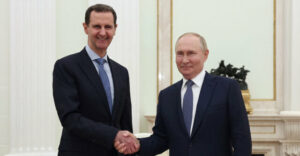
Syria’s central bank, under Bashar al-Assad, airlifted some $250 million in cash to Moscow between 2018 and 2019, a period during which the Syrian dictator’s regime was utterly dependent on Russian military support.
Documents revealed by Financial Times show that the transfers – which included banknotes weighing a total of nearly two tonnes – were made by air flights to Moscow’s Vnukovo. The money was deposited in Russian banks that had already been sanctioned at the time.
These unusual transfers from Damascus show how Russia, a key ally of Assad who helped keep him in power, became a key destination for Syrian money as Western sanctions cut the country off from the global financial system.
Opposition figures and Western states have openly accused Assad of stealing Syria’s wealth and using criminal activities to fund his military and personal ambitions. At the time of the money transfers, Syria was dependent on Russian military support, including mercenaries from the Wagner Group, while members of the Assad family bought luxury properties in Moscow.
David Schenker, former US Undersecretary of State for Near East Affairs, said he was not surprised that the Syrian dictator was sending such large sums of money to Russia. “The Assad regime transferred its ill-gotten gains overseas to ensure a luxurious lifestyle for its elite,” he said.
The wealthy wealthy would be able to enjoy the wealth of his wealthy elite to the benefit of his wealthy elite.
In $100 and €500 bills the transfers
Between March 2018 and September 2019, Syria’s central bank made 21 flights to Moscow, transferring a total of more than $250 million in $100 and €500 bills.
Records show that in May 2019, one flight carried $10 million, while in February of that year, 20 million euros were carried.
According to the Financial Times, no such transfers were recorded before 2018. According to sources familiar with the Syrian Central Bank system, Syria’s foreign exchange reserves had been almost entirely depleted by then, and the regime was forced to make cash payments for grain purchases, printing banknotes and “defense” spending.
The money ended up in two Russian banks: the Russian Financial Corporation Bank (RFK), controlled by the state-owned arms export company Rosoboronexport, and the TsMR Bank. Both of these banks have been sanctioned by the US Treasury Department for facilitating illegal transactions and circumventing sanctions on behalf of the Assad regime.
Russian records also show that Moscow provided Syria with security paper for printing banknotes and freshly printed Syrian banknotes in previous years. However, there is no evidence of any other mass transfers of cash from Syria to these banks in the last decade.
Despite Syria’s shattered economy, Assad and those in his inner circle have maintained control of critical sectors of the economy over the past six years. His wife, Asma al-Assad, a former JP Morgan banker, played a central role in managing humanitarian aid reaching the country and headed a secret economic council.
Since 2013, members of the Assad family have bought at least 20 luxury apartments in Moscow through complex corporate “routes” and loans.
In 2022, Assad’s cousin, Iyad Maklouf, founded the Zevelis City real estate company in Moscow with his brother, Ihab.
Iyad Maklouf was a former official of the Syrian Intelligence Service (which reportedly monitored, tortured, and murdered civilians) and maintained close ties with the Assad couple, even after the “fall” of his other brother, Rami Maklouf, a businessman who controlled half of the Syrian economy before breaking with the Syrian dictator.
Ask me anything
Explore related questions