




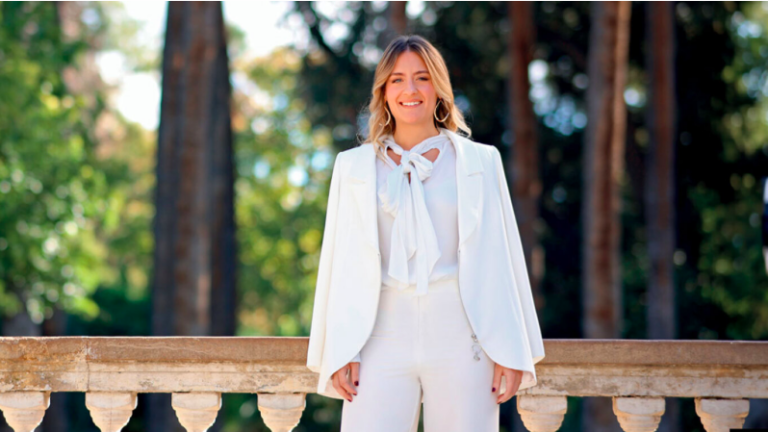
She traverses the coordinates of Greece with the same speed that she moves from the coordinates of love to those of giving, through the foundation that carries the heavy name of her family. Meet a different woman of private initiative, who dedicates far more than her time to the less fortunate people across the country. Elisavet Hatzigaki, General Secretary of the Board & Head of Programs and Communications of the Hatzigaki Foundation, has the floor.
GALA: If you had to prioritize, according to your personal values, Education, Welfare, Culture, Health, and the Environment—fields in which the foundation is active—what order would that be and why?
ELISAVET HATZIGAKI: I would prioritize Education. Through Education, we have the opportunity to shape a different society, cultivate new ideologies and practices, break down stereotypes, eliminate pathologies, and combat half-knowledge and misinformation. Most importantly, through Education, we can redevelop life skills. Education is one of the strategic pillars of our mission and is manifested in the Hatzigaki Foundation’s educational programs. Following that order, would come the Environment, Welfare, Health, and Culture.
G.: Over the years you’ve been actively involved with the foundation, what story stands out as the most impactful for you?
E.H.: I have two stories to remember. Through the Education & Environment Program, I found myself on a small, remote island in the South Aegean with a single elementary school student, who, when we talked about clean beaches and went to the only beach on the island to “save” it from waste, admitted that he had never noticed the beach, which was right in front of his house and was filled with all kinds of trash. It was a characteristic example of the one-dimensional perception we all have about environmental pollution. The second story is from Thessaly, when the foundation team and I were on the front line just days after the “Daniel” floods in September 2023, in Palamas, Karditsa, delivering the first humanitarian aid shipments, totaling 13 tons (basic necessities, food, bedding, etc.). There, we met an elderly lady who had two grandchildren in an empty house covered in mud with no furniture: she was willing to give the new pillows we had brought to her grandchildren because she could no longer sleep.
G.: And something that touched you more deeply?
E.H.: Every time I visit a distant, remote area on the map, I am deeply touched by the love and warmth I feel when I interact with local communities, with people who share their stories, the stories of their land. I learn from them, and there is this sudden feeling of “belonging,” which is simply magical. But I am also deeply touched by the thirst for knowledge and the energy for action that I feel every time from children of all ages in remote areas of our country who lack a balanced social life due to a small population or the absence of peers. They lack strong stimuli and often basic equipment, yet they have remarkable acuity, sensitivity, and a desire to learn and grow with the aim of bringing change to their land.
G.: What, in your opinion, is the greatest help someone can offer to others, beyond financial support?
E.H.: To be human. Financial support only has value when it comes from a deeply sincere sense of humanity; otherwise, it often feels like a cold transactional act. Our society is plagued by “closed doors” and “closed mouths.” However, in recent years, significant efforts are being made in public life to stand up against a series of prejudices and distortions that create a stifling atmosphere of silence or oppression, which often leads to outlets like violence. So, the greatest help is to have open ears, open eyes, and an open heart. We must be ready at any moment to offer a helping hand, a freshly cooked meal, a school bag, a toy, a warm hug to our fellow human beings, starting from our neighborhood and extending to Parliament.
G.: On a personal level, how has your involvement with the Hatzigaki Foundation affected you?
E.H.: It has been a multidimensional, exciting journey for me so far at the foundation, with many and different stages, unexpected challenges, and beautiful surprises. I admittedly took on many responsibilities at a young age with a large volume of tasks, but at the same time, the trust shown to me by the family and all the members of the Hatzigaki Foundation provided a significant boost for great freedom of movement and decision-making. As my role expands, I discover more aspects of myself. Through my contribution to the foundation’s mission, I started to have a more holistic, informed view of the world and the impact I would like to leave on it. I come into contact with hundreds of different human stories, and this holistic perspective informs the decisions I make daily. The responsibility is enormous, and it took a long time for me to realize the weight each decision carries, but also the value of the final outcome. Lastly, traveling across Greece, building beneficial bonds and communication bridges with many different people, I have learned to be more observant, focusing on the particular details that have the power to determine the outcome of a situation, positively or negatively.
G.: Does private initiative complement or replace the state when needed?
E.H.: I believe private initiative should not replace the state. Private initiative plays a complementary role in a beneficial coexistence with the state. It comes to set the framework for good practices and new standards of action, investing in innovation, research, and programs that promote the holistic evolution of society. However, this is only possible when the state has ensured the provision of infrastructure, platforms, action plans, and legislations that address and satisfy the basic needs of society. So, for me, ideally, the role of a charitable foundation is to cultivate fertile ground, directing resources and expertise purposefully so that society moves a step further up the ladder of progress, rather than being called upon to take on a role in covering a flood of basic needs, which usually fall within the effective functioning of state mechanisms. In the years I have been involved with the foundation, I have seen wonderful, multifaceted projects realized when private initiative works in absolute coexistence with the state.
G.: Is there a goal you envision for the coming years?
E.H.: My personal vision is for the Hatzigaki Foundation to become a shining example of mobilization, activation, and inspiration with good, holistic practices that will guide us in establishing an ecosystem of multiple actions, with active contributions from everyone—from every sector of society: businesses, local and regional authorities, academic institutions, non-profit organizations, and, of course, citizens. Also, expanding our programs to promote six key areas: 1. Decision-making and problem-solving. 2. Creative and critical thinking. 3. Communication and interpersonal relationship skills. 4. Self-awareness and empathy. 5. Emotion and stress management. 6. Experiential learning. At the same time, strengthening our strategic alliances is crucial for the sustainable realization of this vision. I firmly believe, having repeatedly experienced this in practice, that only together can we bring about real changes for tomorrow, which may now seem uncertain, bleak, and gray, but together we will make it bright, sustainable, and hopeful. When one supports another, they learn and draw strength from them and become stronger. The “together” outweighs everything.
Ask me anything
Explore related questions