





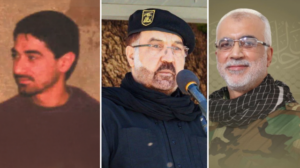
Israel has targeted Hezbollah commanders in airstrikes in Beirut amid an escalating conflict with the Iranian-backed Lebanese group.
Indeed, Reuters has released a list of Israeli operations in Lebanon in which leaders and Hezbollah officials have died.
Muhammad Hussein Sarour
A new wave of Israeli “precision strikes” on Beirut was launched today by the Israeli military, targeting the commander of Hezbollah’s air force, Muhammad Hussein Sharour.
As the IDF made known, Sharour was killed in the Israeli airstrike. According to the Israeli military, Sharour directed several airstrikes against Israel, including explosive drones and cruise missiles. In recent years, the IDF says he led the construction of Hezbollah drones and set up sites in Lebanon where the group built UAVs, some of which were located under civilian buildings in Beirut.
Sharour joined Hezbollah in the 1980s and held various positions, including in the terrorist group’s air defense, the Aziz unit in the Radwan force and as a Hezbollah attaché in Yemen, where he participated in the Houthi air force, according to the Israeli military.
Ibrahim Kubaisi
An airstrike on the southern suburbs of Beirut on September 24 killed Ibrahim Qubaisi, a commander and leading member of Hezbollah’s missile division, two security sources said.
Ibrahim Akil
An Israeli strike on the southern suburbs of Beirut killed on September 20 Hezbollah’s operations commander, Ibrahim Akil, who served in the organization’s top military body. Akil, who also used the pseudonyms Tahsin and Abdelqader, was a member of Hezbollah’s top military body, the Jihad Council.
The U.S. accused him of involvement in the truck bombings in Beirut that hit the U.S. embassy in April 1983, killing 63 people, and a U.S. Marine barracks six months later, killing 241 people.

Ahmet Wahbi
Ahmed Gahbi, was a senior commander overseeing Special Forces Radwan military operations in the Gaza war until early 2024, was killed in an Israeli strike targeting several senior commanders in the Beirut suburbs on September 20, including Ibrahim Akil.
Fuad Shukr
An Israeli strike on the southern suburbs of the Lebanese capital on July 30 killed Hezbollah supreme commander Fouad Shoukr, identified by the Israeli military as the right-hand man of Hezbollah chief Syed Hassan Nasrallah.
Fouad Shoukr has been one of Hezbollah’s leading military figures since it was founded by the Iranian Revolutionary Guards more than four decades ago. The US imposed sanctions on Sukkr in 2015 and accused him of playing a central role in the 1983 bombing of the US Marine barracks in Beirut, which killed 241 US servicemen.
Mohammed Nasser
Mohammed Nasser was killed in an Israeli airstrike on July 3. Israel claimed responsibility, saying he was in charge of a unit responsible for firing from southwestern Lebanon against Israel. Nasser, a senior Hezbollah commander, was in charge of part of Hezbollah’s border operations, according to senior security sources in Lebanon.
Taleb Abdullah
Hezbollah’s senior field commander Taleb Sami Abdullah was killed on June 12 in an attack claimed by Israel, which said it had struck a command and control centre in southern Lebanon. Security sources in Lebanon said he was the head of Hezbollah, commander of the central area of the southern border strip and held the same rank as Nasser. His assassination prompted the group to launch massed fire and missiles along the border into Israel.
Israel’s “no” to ceasefire
Israel is “not going to go for a ceasefire now” according to a member of Israeli Prime Minister Benjamin Netanyahu’s advisors, amid escalating relations with Hezbollah in Lebanon. The issue was not raised in yesterday’s cabinet meetings, the official said. “We remain determined to return the residents [of the north] to their homes safely,” the official noted.
“We are continuing with the war plan approved by the prime minister.” “If [Hezbollah chief Hassan] Nasrallah has not understood the message by now, he will understand it in a different way,” the official concluded.
US: An all-out war would be disastrous for Israel and Lebanon
US Defense Secretary Lloyd Austin said today that a “total war” between Israel and Hezbollah would be disastrous for both Israel and Lebanon. The US Secretary called for a “diplomatic solution” as Israel’s massive air strikes continue in disputed areas of Lebanon.
“We face the risk of an all-out war” that “would be catastrophic for both Israel and Lebanon,” said the US defence secretary, who is in London for contacts with his British and Australian counterparts. He added that a possible ceasefire agreement “could also serve to establish and implement a ceasefire in the Gaza Strip.”
Ask me anything
Explore related questions