





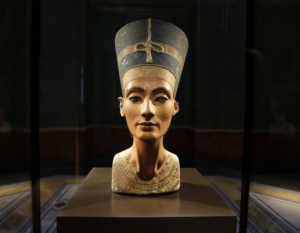
A saga, similar to that of the illegally removed Parthenon Sculptures housed in the British Museum, has been unfolding for 100 years regarding one of the most significant works of ancient Egyptian art. This is the priceless and uniquely beautiful bust of Queen Nefertiti, which has been “imprisoned” in Germany since 1924, despite repeated requests for its return or even its loan.
The longtime advocate for the repatriation of the bust, which has become a global symbol of female beauty, is the distinguished archaeologist and former Minister of Antiquities, Zahi Hawass. Since 2005, he has not ceased his efforts and is calling on the global public to take an active stance against the looting of cultural artifacts by Europeans: “Today, we announce that Egypt, through a national, non-governmental committee, is requesting the return of the bust of Nefertiti. This must be the year when artifacts from African countries and other cultures are returned to their places of origin,” he stated, urging the international public to sign the petition in support of the request on his website.
The Discovery and Illegal Transport to Germany
The 48 cm tall and 20 kg heavy bust, made of limestone and plaster and intricately painted, dates back to 1345 BC and is attributed to the sculptor Thutmose. It was found in 1912 in his workshop in Tell el-Amarna, then the capital of Egypt. Although it was not accompanied by any identifying inscription, it was identified as the first wife of Pharaoh Akhenaten, who ruled in the 14th century BC, through comparisons with other depictions of her.
This unique artifact, which is now housed in Berlin’s Neues Museum, came to light during a German archaeological expedition led by Ludwig Borchardt. Borchardt played a dirty trick to take the bust back to his homeland. According to the agreement between Egypt and Germany at the time, the export of significant archaeological finds was prohibited. However, the German archaeologist deceived the Egyptian authorities by claiming that the bust of Nefertiti was merely a simple, insignificant sculpture. To further support this claim, he presented the bust covered in mud to hide its impressive craftsmanship, successfully smuggling it out of Egypt. This deceit mirrors the dubious methods used by Lord Elgin with the fake Ottoman license regarding the Parthenon Sculptures.
The Requests for Its Return
Indeed, the bust of Nefertiti made its way to Berlin, but for an entire decade, it was kept hidden upon Borchardt’s urging to the German authorities, fearing that his deception would be exposed. However, when it was first displayed in 1924 at Berlin’s Neues Museum, the truth could no longer be concealed. By 1925, Egypt officially requested the return of the valuable artifact, even threatening to ban German excavation teams from working in Egypt if its request was not granted. However, Egypt received a resounding “no.”
Four years later, in 1929, Egypt modified its approach, proposing a trade, offering other Egyptian antiquities in exchange for Nefertiti. Yet again, Berlin’s response was negative.
During the 1930s, amid political attempts to improve relations with Egypt, a high-ranking Nazi official suggested returning the bust as a gesture of goodwill to secure Egypt’s support for the Nazi expansion. However, Hitler, captivated by Nefertiti’s uniqueness and beauty, refused to hand her over, making only a false promise to build a grand museum in Egypt where it would eventually be displayed.
During World War II, the bust was stored in a salt mine for protection. In 1946, the American military discovered it but refused to return it to Egypt, instead referring Egyptian authorities to negotiations with the new German government. Over the following years, numerous official requests were made for Nefertiti’s return, but none were successful. At the same time, the bust became a point of contention between East and West Germany. Ultimately, in 2009, the bust returned to the Neues Museum in Berlin, where it remains to this day.
Despite Germany’s official stance, which continues to assert legal ownership (though they cannot fully substantiate this), Egypt persists in its rightful demand for the return of the bust. The ongoing campaign led by Zahi Hawass emphasizes that the bust’s original export was, without a doubt, illegal, serving as the main argument for its repatriation.
Ask me anything
Explore related questions