

×
GreekEnglish

×
  • Politics
  • Diaspora
  • World
  • Lifestyle
  • Travel
  • Culture
  • Sports
  • Cooking
Friday
23
Jan 2026
weather symbol
Athens 11°C
  • Home
  • Politics
  • Economy
  • World
  • Diaspora
  • Lifestyle
  • Travel
  • Culture
  • Sports
  • Mediterranean Cooking
  • Weather
Contact follow Protothema:
Powered by Cloudevo
> Culture

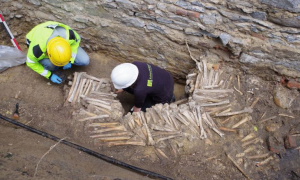
Walls made of ancient human leg bones found beneath Belgian church

The macabre creations are likely the product of an overcrowded cemetery cleared out hundreds of years ago

Newsroom July 5 02:58

More than 100 billion people have died since the Homo sapiens lineage first appeared roughly 50,000 years ago. And with so many bodies to bury, civilizations have repeatedly run out of convenient places to put them.

But humans are a resourceful bunch. To make room for new graves, the residents of Ghent, Belgium, apparently dug up some old burial grounds and assembled the bones interred within into nine walls. As Alan Hope reports for the Brussels Times, archaeologists conducting excavations ahead of construction of a cathedral’s new visitor’s center have now unearthed the remnants of these ghastly architectural feats.

See Also:

Mert Kaya: Greeks must know someone is working for Islamized Greeks in Turkey

>Related articles

The old Acropolis Museum reopens, revealing the hidden life of the sacred rock

“All cash”: Netflix is preparing a strategic move to accelerate its $83 billion deal with Warner Bros.

Why Gen Z is returning to religion: what new research in the United Kingdom shows

Discovered beneath Saint Bavo’s Cathedral, home of the famed Ghent Altarpiece, the newly discovered bone walls probably served a similar purpose to the catacombs of Paris, providing a second home for skeletal remains crowded out of old cemeteries.

So-called ossuaries aren’t uncommon, but typically, these chambers manifest in the form of loose pits filled with bones. The carefully constructed walls represent a first for Belgium, writes Janiek de Gryse, the archaeologist who led the excavation, in an email to Live Science’s Laura Geggel.

Read more: smithsonianmag

Ask me anything

Explore related questions

#archaeology#belgium#bones#church#civilization#culture#discovery#macabre
> More Culture

Follow en.protothema.gr on Google News and be the first to know all the news

See all the latest News from Greece and the World, the moment they happen, at en.protothema.gr

> Latest Stories

Reactions in Italy to company survey: ‘Which colleague would you like to fire’

January 23, 2026

Finland calls for a plan for Arctic security by next NATO meeting

January 22, 2026

Metron Analysis: from 12.9% to 16%, the lead of ND in one month, 50% for Karstianos’ popularity

January 22, 2026

Five companies donate a new voice communication and recording system to Greece’s Civil Aviation Authority

January 22, 2026

Mitsotakis: ‘Yes to 13 Countries Joining the Peace Council — but Only for Gaza’

January 22, 2026

The Ukrainian murderer of the hotelier in Rhodes was arrested in Munich

January 22, 2026

EODY: Seven deaths from flu in the last week and 23 hospitalisations in intensive care units

January 22, 2026

Guilfoyle: A ‘window’ for US–Europe agreements

January 22, 2026
All News

> Lifestyle

How old are your lungs? The simple at-home test that gives the answer

What a new large study reveals about respiratory function over time – How to check your lungs yourself at home

January 22, 2026

Farah Diba Pahlavi, the story of Iran’s first and last “empress”

January 22, 2026

Fotini Pelouso: Her roots in Thebes, the hardest Greek word, and her favorite scene in ‘The Great Chimera’

January 22, 2026

The Italian fashion designer Valentino has died at the age of 93

January 19, 2026

A treat for readers: Dior, bags, and literature

January 16, 2026
Homepage
PERSONAL DATA PROTECTION POLICY COOKIES POLICY TERM OF USE
Powered by Cloudevo
Copyright © 2026 Πρώτο Θέμα