





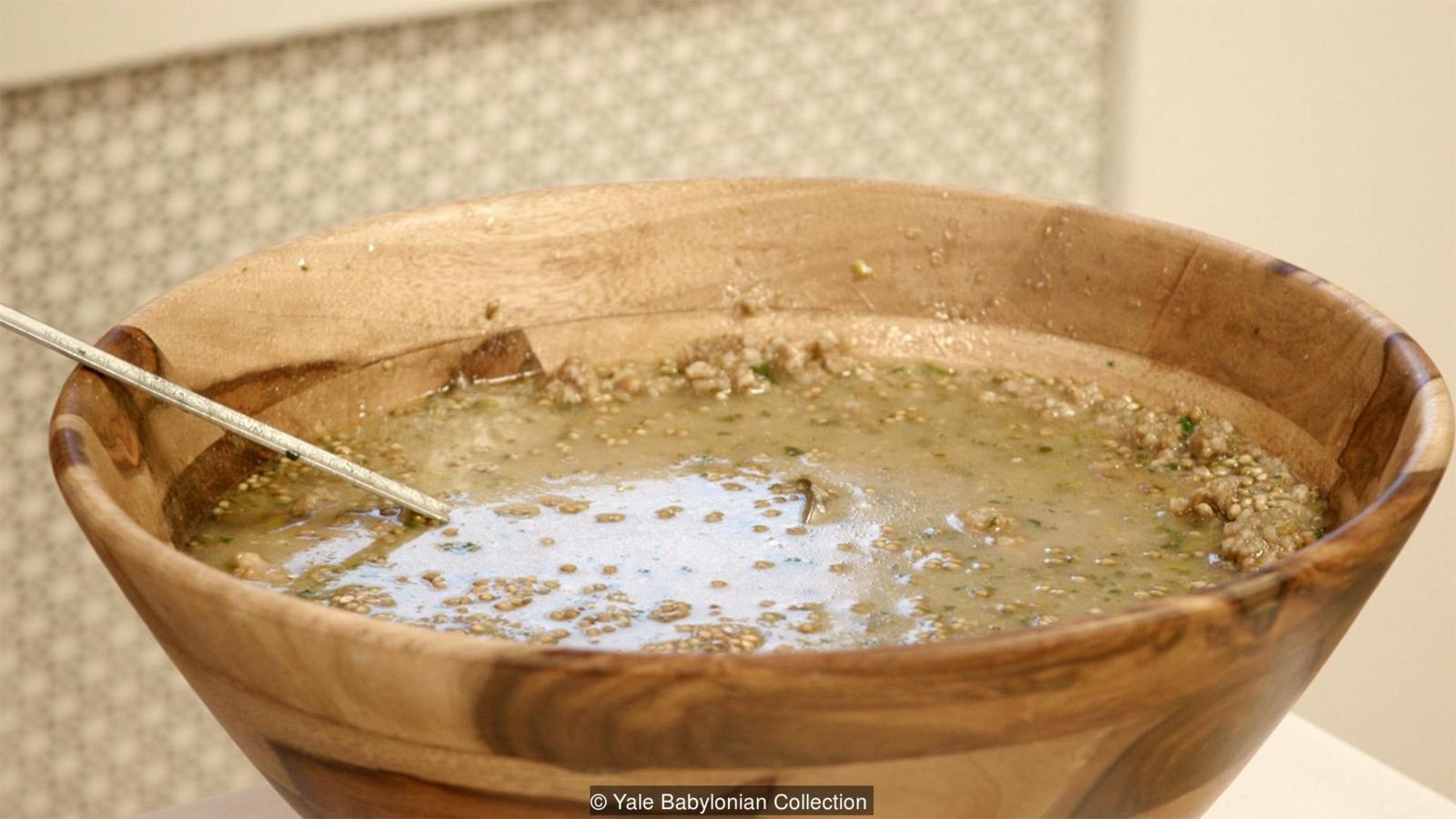
The instructions for lamb stew read more like a list of ingredients than a bona fide recipe: “Meat is used. You prepare water. You add fine-grained salt, dried barley cakes, onion, Persian shallot, and milk. You crush and add leek and garlic.” But it’s impossible to ask the chef to reveal the missing pieces: This recipe’s writer has been dead for some 4,000 years.
Instead, a team of international scholars versed in culinary history, food chemistry and cuneiform (the Babylonian system of writing first developed by the ancient Sumerians of Mesopotamia) have been working to recreate this dish and three others from the world’s oldest-known recipes. It’s a sort of culinary archaeology that uses tablets from Yale University’s Babylonian Collection to gain a deeper understanding of that culture through the lens of taste.
“It’s like trying to reconstruct a song; a single note can make all the difference,” said Gojko Barjamovic, pointing to the paperback-sized tablets under glass at the Yale Peabody Museum of Natural History. Barjamovic, a Harvard University Assyriology expert, retranslated the tablets and put together the interdisciplinary team tasked with bringing the recipes back to life.
Three of Yale’s tablets date to around 1730BC, and a fourth is from about 1,000 years later. All of the tablets are from the Mesopotamian region, which includes Babylon and Assyria – what is today the regions of Iraq south of Baghdad and north of Baghdad, including parts of Syria and Turkey. Of the older three tablets, the most intact is more of a listing of ingredients that amounts to 25 recipes of stews and broths; the other two, containing an additional 10-plus recipes, go further in-depth with cooking instructions and presentation suggestions, but those are broken and therefore not as legible.
Tuh’u recipe
Ingredients:
1 lb leg of mutton, diced
½ c rendered sheep fat
1 small onion, chopped
½ tsp salt
1 lb beetroot, peeled and diced
1 c rocket, chopped
½ c fresh coriander, chopped
1 c Persian shallot, chopped
1 tsp cumin seeds
1 c beer (a mix of sour beer & German Weißbier)
½ c water
½ c leek, chopped
2 garlic cloves, peeled and crushedFor the garnish:
½ c fresh coriander, finely chopped
½ c kurrat (or spring leek), finely chopped
2 tsp coriander seeds, coarsely crushedInstructions: Heat sheep fat in a pot wide enough for the diced lamb to spread in one layer. Add lamb and sear on high heat until all moisture evaporates. Fold in the onion and keep cooking until it is almost transparent. Fold in salt, beetroot, rocket, fresh coriander, Persian shallot and cumin. Keep on folding until the moisture evaporates. Pour in beer, and then add water. Give the mixture a light stir and then bring to a boil. Reduce heat and add leek and garlic. Allow to simmer for about an hour until the sauce thickens.
Pound kurrat and remaining fresh coriander into a paste using a mortar and pestle. Ladle the stew into bowls and sprinkle with coriander seeds and kurrat and fresh coriander paste. The dish can be served with steamed bulgur, boiled chickpeas and bread.
(Source: Food in Ancient Mesopotamia, Cooking the Yale Babylonian Culinary Recipes, with permission from co-author and translator Gojko Barjamovic.)
The challenge was to peel back the layers of history while also maintaining authenticity amid the limitations of modern ingredients.
“They’re not very informative recipes – maybe four lines long – so you are making a lot of assumptions,” said Pia Sorensen, a Harvard University food chemist who worked, along with Harvard Science and Cooking Fellow Patricia Jurado Gonzalez, on perfecting the proportions of ingredients using a scientific approach of hypothesis, controls and variables.
(The instructions for lamb stew read more like a list of ingredients)
“All of the food materials today and 4,000 years ago are the same: a piece of meat is basically a piece of meat. From a physics point of view, the process is the same. There is a science there that is the same today as it was 4,000 years ago,” Jurado Gonzalez said.
The food scientists used what they know about human tastes, preparation essentials that don’t drastically change over time, and what they hypothesized might be correct ingredient proportions to come up with their best guess as to the closest approximation of an authentic recipe.
“This idea that we can be guided by what works – if it’s too liquidy, it’s going to be a soup. By looking at the material parameters, we can zoom in on what it is” – in most cases, a stew, Sorensen said.
What the researchers revealed shows, in part, the evolution of a lamb stew that is still prevalent in Iraq, hand-in-hand with a glimpse back in time at the “haute cuisine of Mesopotamia” that highlights the sophistication of 4,000-year-old chefs, said Agnete Lassen, associate curator of the Yale Babylonian Collection.
Read more: bbc
Ask me anything
Explore related questions