





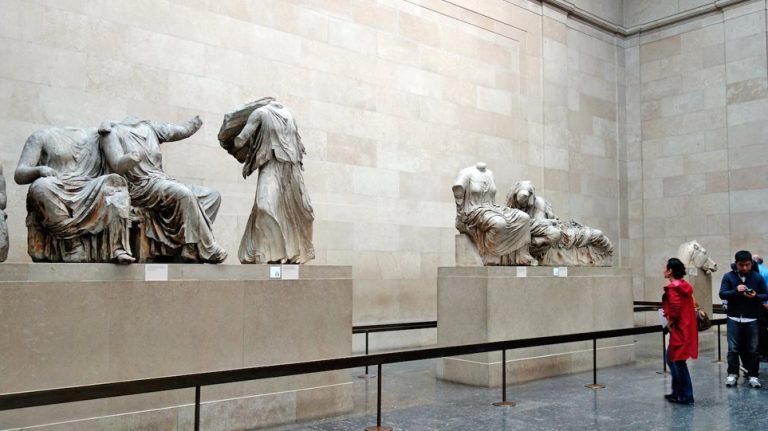
In an effort to mitigate the controversy caused by the British Museum Director ’Hartwig Fischer’s rather uncouth solution to the Parthenon Marbles dispute between Greece and the UK, who had justified the stealing of the marbles by Elgin as “a creative act, a new article appeared in the British newspaper The Guardian entitled “My solution to the Parthenon Marbles – let’s split them”.
The author, a 37-year-old lawyer from Switzerland named Florian Schmidt-Gabain, attempts to lay out the argument that both Greece and the UK could benefit from the Parthenon marbles and share the artefact giving an example of how a cultural war can end in peace.
Both sides, the Britons as well as the Greeks, have valid arguments. Maybe even the Greek gods would have had difficulty in deciding whether the marbles -should be kept in the British Museum or returned to Greece. It may well be that they would have come to the same point as they did in Aeschylus’s play The Eumenides: a stalemate. An equal number of votes for and against restitution. However, and unlike what happens in The Eumenides, in the case of the marbles, this would not be a catastrophe.
For it is not necessary to decide whether they should stay in London or travel to Athens. Instead, there is an easier and obvious solution: a 50:50 share. The British Museumkeeps one half of the marbles and Greece takes the other half. Of course, there would be disputes about who gets what. But those aren’t disputes that can’t be resolved. The marbles don’t consist of one major piece and a lot of minor pieces. There are almost only major pieces. This is a unique situation – and an opportunity – since in many restitution cases sharing doesn’t work. You cannot cut the Nefertiti in half or break the obelisk of the Place de la Concorde in two. Britain and Greece should take advantage of this situation and finally end their feud.
Facsimiles could be made for each collection’s “missing” pieces, if either nation wishes to display a complete set. It will be hard for most people to differentiate the authentic ones and the copies. Maybe European Union funds could be made available, Brexit notwithstanding.
A similar solution was found for a Swiss case. In 1712, Zurich troops invaded St Gallen and its abbey library and brought back precious books and a rare globe of extraordinary size. For decades, St Gallen demanded restitution of the looted items. Finally, in 2006, Zurich and St Gallen agreed that one of the most exquisite books would be returned to St Gallen, that 40 books remain on loan from St Gallen for at least 40 years, that the globe be moved from a museum of the canton of Zurich to the Swiss national museum and that a facsimile of the globe be produced for St Gallen and funded by the city of Zurich.
read more at theguardian.com
Ask me anything
Explore related questions