





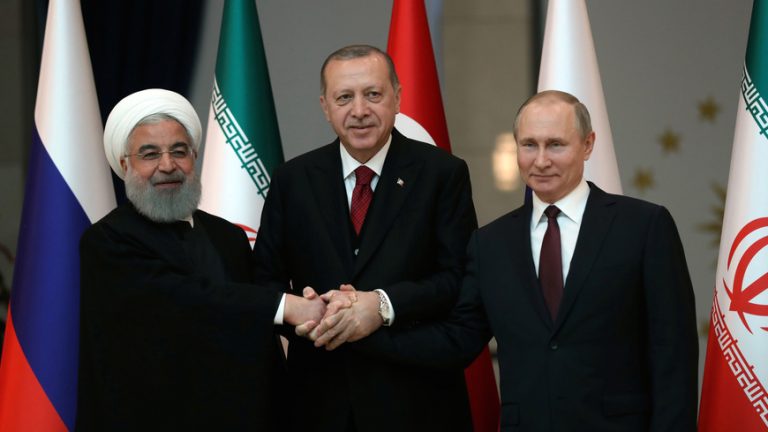
An interesting analysis on the Turkish-Russian relations and how they affect the region.
What’s new? After a rupture in 2015, when Turkish fighter jets downed a Russian warplane over Syria, Russia and Turkey have repaired relations. But a Turkish pivot east does not appear imminent. Ankara and Moscow still compete for influence, and their interests still collide, in the Black Sea and the South Caucasus.
Why does it matter? Anxious at Russia’s increased naval capability and power projection south from Crimea, Turkey has sought a greater role for the North Atlantic Treaty Organization (NATO) in the Black Sea. Russia and Turkey back opposing sides of the Armenia-Azerbaijan confrontation over the disputed territory Nagorno-Karabakh, potentially adding an extra layer of risk to that conflict.
What should be done? Moscow and Ankara are unlikely to resolve the region’s conflicts. But by taking steps to prevent accidental clashes in the Black Sea, improve the plight of Crimean Tatars and encourage Armenia-Azerbaijan dialogue, they could use their broader rapprochement to minimise risks around regional hotspots.
Executive Summary
Russia and Turkey have repaired relations that nearly collapsed after Turkish fighter jets shot down a Russian Su-24 warplane near the Syria-Turkey border in late 2015. Russia has since lifted most of the sanctions it had imposed on Turkey. The two countries coordinate in Syria, have relaunched energy projects and agreed to Turkey’s purchase of Russian S-400 missiles. But Russia-Turkey rivalry is still all too evident in regions sandwiched between the two countries – the Black Sea and South Caucasus. Moscow’s military build-up in Crimea and power projection across the Black Sea has increased Ankara’s reliance on the North Atlantic Treaty Organization (NATO) in that region even as Turkey’s relations with Western powers tank. Russia-Turkey competition in the Caucasus adds an extra layer of risk to hostility between Armenia and Azerbaijan. That Moscow and Ankara would work to resolve regional conflicts thus appears unlikely. Nonetheless, their recent rapprochement could serve to calm flashpoints, or at least mitigate the risk of flare-ups.
Since Turkish President Recep Tayyip Erdoğan’s June 2016 public apology for the Su-24 downing, he and his Russian counterpart, Vladimir Putin, have met more than ten times. Their improved ties owe much to Erdoğan’s need for Russian backing in Syria, including in containing the People’s Protection Units (YPG), the Syrian affiliate of the Kurdistan Workers’ Party (PKK) – a militant group that Turkey, the European Union and the United States list as a terrorist organisation, and which has waged a decades-long insurgency in Turkey.
Warmer relations also owe to Erdoğan’s apparent gratitude for Putin’s support during the July 2016 coup attempt in Turkey and the two countries’ economic ties, which provided strong incentives for both to seek an end to Russian sanctions. They reflect, too, the Turkish leadership’s frayed relations with the West, particularly its anger at the U.S. for supporting the YPG in Syria and refusing to extradite Fethullah Gülen, the Turkish cleric Ankara blames for the failed putsch. Russia-Turkey rapprochement has reached such peaks as to prompt Western concern about Turkey’s commitment to NATO and what some officials perceive as Ankara’s pivot east.
Such fears are not groundless. But they overlook the continued struggle for influence between Moscow and Ankara in the Black Sea and the South Caucasus. In the former, Russia’s 2014 annexation of Crimea has enabled it to expand its naval capability, project power south and shift the strategic balance in its favour. The annexation has also raised Ankara’s concerns about the plight of the Crimean Tatars, who enjoy historically close ties to Turkey. Turkey has responded with its own military build-up. It has encouraged NATO to deploy into the Black Sea, reversing a decades-old policy of keeping the alliance out. Ankara’s strained links with Western capitals notwithstanding, in the Black Sea at least, NATO is critical to Turkey’s strategic calculations.
In the South Caucasus, too, Russian and Turkish interests collide. Russia and Turkey back opposing sides of the Armenia-Azerbaijan conflict over Nagorno-Karabakh: Moscow has a defence pact with Yerevan (though in practice arms both sides); Ankara has a strategic partnership and mutual support agreement with Baku. That conflict’s flare-up, in April 2016, coincided with the fallout from the Su-24 crisis and provoked a harsh exchange of words between Moscow and Ankara, though both chose not to escalate and Moscow eventually brokered a ceasefire. Indeed, Turkey has been cautious to test Russia only so far in a region where Moscow seeks to be the preeminent power.
Yet any escalation over Nagorno-Karabakh will always carry some risk of sucking in the two regional heavyweights. Their competition adds to the region’s militarisation. At the same time, Moscow’s expanded military footprint in Syria, Armenia, Georgia’s breakaway regions of Abkhazia and South Ossetia, and on the Crimean peninsula fuels Turkish fears of encirclement.
While Russia and Turkey have different, often conflicting, objectives in the region, their rapprochement might open an opportunity for the two countries to prevent flare-ups in their shared neighbourhood:
– Ankara might use its ties to both NATO and Russia to mitigate the risk of incidents in the Black Sea, which has increased as both Russia and NATO expand their presence and conduct military exercises, with Russian jets “buzzing” or intercepting NATO planes. Dialogue at all levels is essential, and Turkey might facilitate additional channels of communication.
– Prospects for resolving the Nagorno-Karabakh conflict are slim, but Moscow and Ankara could work to prevent another outburst, emphasise to both sides the long-term benefits of peace in a region crucial for transit between Asia and Europe and the Middle East and Russia, and prompt both to offer mutual concessions.
– Ankara should use its improved relations with Moscow to engage the Russian leadership on the status and rights of the Crimean Tatars.
Russia-Turkey rapprochement is good news for the Turkish economy and for citizens of both nations who suffered the consequences of Moscow’s sanctions after the Su-24 crisis. Overall, too, it benefits the countries of the Black Sea and the South Caucasus regions that otherwise risked getting caught in the crossfire. Yet despite improved ties, the two countries’ aims and interests still conflict across those regions’ main trigger points. While improved Russia-Turkey ties in themselves will not resolve often protracted conflicts, Moscow and Ankara could harness their imperfect partnership to reduce the danger of flare-ups.
Read the analysis HERE
Ask me anything
Explore related questions
