




Santa Claus is relentlessly trying to enter our European households (mostly through our mailboxes rather than chimneys), but Father Christmas, Baby Jesus, Grandfather Frost, and other traditional gift-bringers have managed to fend him off so far (well, sort of).
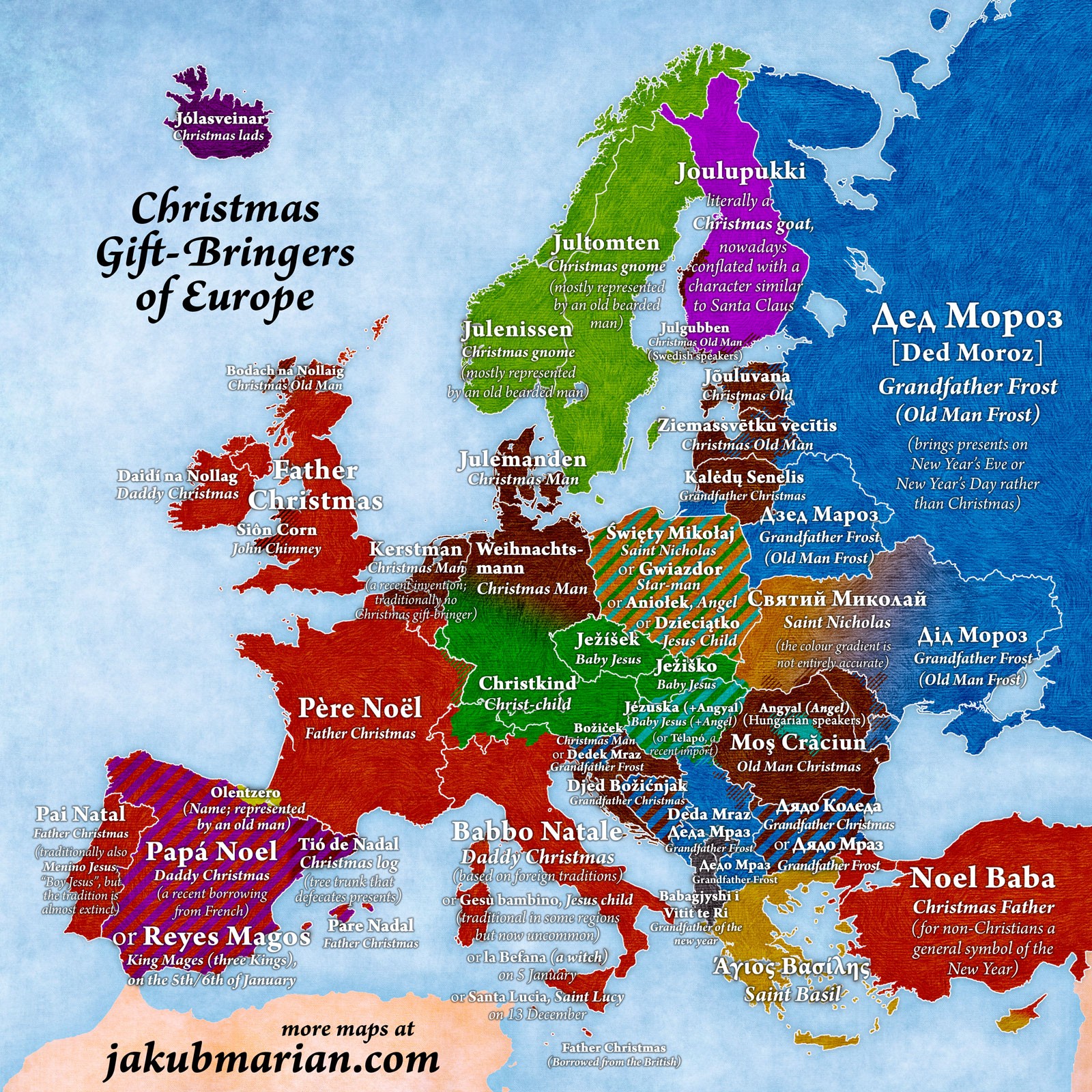
Each country (or region) has its own traditional Christmas gift-bringer. Some of them are quite nice, such as the British Father Christmas, others are outright weird, such as the Catalan “defecating log”, but all of them are equally interesting. The following map shows the gift-bringers’ names with translations, coloured by relatedness of the concepts themselves (that is, not by etymological relatedness of the names).
(Click to enlarge)
Please note that some of the stripes and gradients may not represent the actual geographical distribution completely accurately; they just show general geographical trends. For example, Weinachtsmann is more common in the north of Germany, Christkind (or Christkindl) in the south, but the border is not entirely clear. The situation in Ukraine is even more unclear.
In Poland, the four variants are mostly regional (only one of them is typically common within a certain region). However, since there is not enough space in the map to show the regional variations, Poland is simply shown with stripes. There is also another variant, Gwiazdka (meaning “little star”), which is related to Gwiazdor and which did not fit in the map. Another, even less common one, is Dziadek Mróz (Grandfather Frost), imported from eastern Slavs.
In Spain, the traditional Christmas gift-bringers are the Three Kings who give Children presents on the night of the 5th of January or the morning of the 6th of January, but the tradition is partly becoming replaced or supplemented by Papá Noel (influenced by Santa Claus, name imported from France), who brings gifts on Christmas Eve.
In Russia and several other members of the former Eastern Bloc, Ded Moroz gives presents to Children on New Year’s Eve rather than Christmas Day. Although he was originally a pagan character, in the 19th century he became a Christmas figure, akin to Father Christmas and other Western European traditions. During the Soviet era, when celebration of Christmas was discouraged (and in some countries even completely forbidden), he became the symbol of New Year’s celebrations.
In Hungary, the traditional Christmas gift-bringer is Jézuska (often accompanied by an angel), while Télapó is equivalent to Saint Nicholas (who brings presents on the 5th or 6th of December). However, there are also families in which Télapó brings presents at Christmas (likely under the influence of Santa Claus)… At least according to some of my readers, who insisted that I add it.
Here’s the same information as above in the form of an alphabetical list:
Albania: Babagjyshi i Vitit te Ri, Grandfather of the new year
Austria: Christkind, Christ-Child
Belarus: Дзед Маро́з, Grandfather Frost (or the Russian version)
Belgium:
– Dutch: Kerstman, Christmas Man
– French: Père Noël, Father Christmas
Bosnia: Djed Božićnjak, Grandfather Christmas or Djeda Mraz, Grandfather Frost
Bulgaria: Дядо Коледа, Grandfather Christmas or Дядо Мраз, Grandfather Frost
Croatia: Djed Božićnjak, Grandfather Christmas
Cyprus:
– Greek: Άγιος Βασίλης, Saint Basil
– Turkish: Noel Baba, Christmas Father
Czech Republic: Ježíšek, Baby Jesus
Denmark: Julemanden, The Christmas Man
Finland: Joulupukki, literally Christmas Goat
France: Père Noël, Father Christmas
Germany: Weihnachtsmann, Christmas Man or Christkind, Christ-Child
Greece: Άγιος Βασίλης, Saint Basil
Hungary: Jézuska, Baby Jesus (with an angel), or Télapó, Winter Old Man
Iceland: Jólasveinar, Christmas lads
Ireland: Father Christmas
– Irish: Daidí na Nollag, Father Christmas
Italy: Babbo Natale, Daddy Christmas
Lithuania: Kalėdų Senelis, Grandfather Christmas
Latvia: Ziemassvētku vecītis, Christmas Old Man
Estonia: Jõuluvana, Christmas Old
Former Yugoslav Republic of Macedonia (FYROM): Дедо Мраз, Grandfather Frost
Montenegro: Деда Мраз, Grandfather Frost
Netherlands: Kerstman, Christmas Man
Norway: Julenissen, literally Christmas gnome
Poland: Święty Mikołaj, Saint Nicholas; Gwiazdor, Star-man; Gwiazdka, Little Star; Aniołek, Angel; or Dzieciątko, Jesus Child (depending on region)
Portugal: Pai Natal, Father Christmas
Romania: Moş Crăciun, Old Man Christmas
– Transylvania (Hungarian): Angyal, Angel
Russia: Дед Мороз, Grandfather Frost
Serbia: Деда Мраз, Grandfather Frost
Slovakia: Ježiško, Baby Jesus
Slovenia: Božiček, Christmas Man or Dedek Mraz, Grandfather Frost
Spain: Papá Noel, Daddy Christmas or Reyes Magos, Three Kings
– Catalonia: Tió de Nadal, Christmas log
– Basque: Olentzero (proper name, represented by an old man)
Sweden: Jultomten, literally Christmas gnome
Switzerland:
– German: Christkind, Christ-child
– French: Père Noël, Father Christmas
– Italian: Babbo Natale, Daddy Christmas
Turkey: Noel Baba, Christmas Father
Ukraine: Святий Миколай, Saint Nicholas or Дід Мороз, Grandfather Frost
United Kingdom: Father Christmas
– Welsh: Siôn Corn, John Chimney
– Scottish Gaelic: Bodach na Nollaig, Christmas Old Man
Source: jakubmarian.com
Ask me anything
Explore related questions