





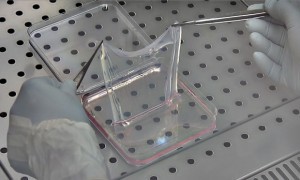
Scientists have grown a replacement, genetically modified skin to cover almost the entire body of a seven-year-old Syrian boy who was suffering from a devastating genetic disorder.
The treatment marks a rare and striking success for the field of regenerative medicine, which has been struggling to transform futuristic-sounding science into therapies that make a difference to patients. In the latest trial, the life of the young boy – whose illness had come close to killing him – was transformed.
Before undergoing surgery, the boy had lost 80% of his skin, leaving him covered in untreatable, infected wounds. He was given morphine to cope with the pain and his doctors were preparing to start palliative treatment after all conventional therapies had failed.
Prof Cédric Blanpain, a stem cell scientist at the Free University of Brussels, described the work as one of the most impressive examples to date of the use of stem cells in humans. “There are very few diseases that have benefitted so far,” he said. “This is a beautiful example of something that was unthinkable before the study. To replace and gene-correct the whole skin of a patient is just amazing.”
Claire Higgins, a lecturer of bioengineering at Imperial College London, described the trial as “a huge achievement and quite remarkable”.
Claire Higgins, a lecturer of bioengineering at Imperial College London, described the trial as “a huge achievement and quite remarkable”.
The boy, who arrived in Germany in 2013 after his family fled Syria as refugees, was suffering from a genetic disease called junctional epidermolysis bullosa, which causes the skin to become fragile and blister. By the time he came to be treated, he had lost the surface layer of skin, called the epidermis, from almost his entire body, with only the skin on his head and a patch on his left leg remaining intact.
His doctors, based at University Children’s Hospital, Ruhr University Bochum, had attempted to graft skin from his father, but the transplant had been rejected. As a last resort, the team sought the help of Italian scientists who had pioneered a technique to regenerate healthy skin in the laboratory – but had never attempted to use it for such an ambitious case.
The Italian team, led by Michele De Luca at the University of Modena, had successfully grafted laboratory-grown, genetically modified skin onto small areas of the body, such as part of a leg. “This is the first time that such an amount of body has been transplanted,” said De Luca. “He basically lost almost completely his epidermis.”
The boy’s disease was caused by a mutation in a gene, called LAMB3, that produces a protein that anchors the epidermis to the deeper layers of skin beneath. Without this protein the skin blisters easily, causing chronic wounds and ulcers to form.
The treatment, outlined in a paper in the journal Nature, involved first taking a sample from the patient’s remaining healthy skin. The scientists then genetically modified these skin cells, using a virus to deliver a healthy version of the LAMB3 gene into the nuclei.
The skin contains its own supply of specialised stem cells, which allows the epidermis to be constantly renewed throughout our lives, with cells turning over roughly every month. This also allows scientists to grow grafts in culture, simply by taking a small sample.
In this case, the team grew enough skin to cover almost the entire body of the boy. During two operations in autumn 2015, the new epidermis was attached like a patchwork quilt, covering almost his entire body. Within a month, the graft had integrated into the lower layers of skin.
The genetically modified cells in the graft include specialised skin stem cells that meant once the transplant was integrated it was able to renew and sustain the healthy skin.
source: theguardian.com
Ask me anything
Explore related questions