




It is now 25 years since George Soros and Robert Johnson* speculated against the pound, costing £3.3 billion in losses, and forcing the UK out of the European Exchange Rate Mechanism (ERM) that paved the way for the euro currency.
According to Johnson this “tough love” was necessary!
Why did it take so long to change a flawed economic paradigm? And why are we still in it?
– There is an American author from the 1920s and 1930s, Upton Sinclair, who said: “It is difficult to get a man to understand something, when his salary depends on his not understanding it.”
There is a whole lot of people in positions of prestige, where not understanding that the system is off-track or needing major changes, was a convenient form of denial for them. Things were going very well for 1% to 5% of the population. As they built their money, as they open their think tanks, as they funded their universities, their fantasy of ‘what is good for me is good for everybody’ was very persistent.
It takes courage not only to break out the habits but to break out of these financial relationships. I wasn’t surprised by the resistance. There is an old dilemma among philosophers. Those who say I only believe what I see, which is kind of scientific, and others that say I only see what I believe. I think we have been seeing what we believed, when our beliefs were convenient. Until the system was clearly no longer sustainable.
The system crashed in 2007/2008 partly because of speculation and sophisticated financial products that provoked a chain reaction in America and Europe. You also speculated, and joined George Soros in September 1992 when ‘Black Wednesday’ occurred…
– I was a currency trader and I was brought in for that purpose.
What insights did you get from the markets at that moment and how that changed the way you see the economy today?
– When I joined Soros it was in part because of the friendship I had with him. He told me: ‘I did not hire you to be a security analyst; I hired you to become an insecurity analyst.’ I was looking for where the next source of incoherence and instability was not only the scenario but also the timing of what would be a catalyst of change.
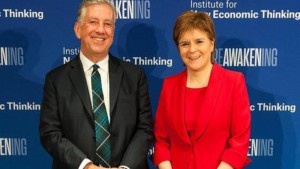
When the financial crisis happened in 2007/2008, Soros and me founded the Institute for New Economic Thinking (INET) based on his own experience. He was a young boy when Germany and Austria had a banking crisis in 1931. In the US, the authorities rescued the financial institutions, and bankers got all their bonuses, but they didn’t bail out the people who lost a lot of money in the houses.
There was unfairness. It was not just a financial crisis. It was a crisis in the legitimacy of the government in America, a crisis in the paradigm of the economy and finance.
Soros and me felt that the financial market model that led to all the deregulation was wrong. But more importantly, we felt that there was a danger to society. In this collapse of confidence and legitimacy, there would be a void.
How do we fill that void?
– INET was designed to fill the void with a constructive view, instead of just sitting and watch people getting mad at each other, because that is what forms the demagoguery.
Obviously, we have not been successful. The turmoil that started in 2008 has continued to build and now has to do with concern about climate, about fairness and inequality.
I am worried about whether democracy can restore the balance in society or whether demagoguery takes over the despairing democracy and destroys the economy, which intensifies the despair. We are at the crossroads of that challenge now. It is time for INET to become bolder, stronger and more vocal. Not to be shaming anybody but to demonstrate that a good economist is mindful of all the consequences for all people.
In light of this stance you have today, and going back to ‘Black Wednesday’, does it mean that you would not have done the short-selling that plunged the pound?
– I don’t think like that. If I was in 1992, and somebody like me saw that picture, I would say, somebody is going to do it. I don’t think George Soros caused the [exit from the] ERM. I think he saw that it was going to happen sooner than other people. I think we got on the train smarter and faster than other people. I don’t think it would have lasted another two months.
I don’t think we were the cause. I think there is a certain celebrity that Soros attained from the aggressive and bold bet. That is almost like an ex-post explanation. There are a lot of bankers in the Netherlands, in Denmark, in Sweden, in the UK who said afterwards ‘I was there too’. But they weren’t quite as big and bold as Soros was.
Part of the reason I went to work with him is because I could see what was coming and I knew he would let me go for it, when the bank I worked with was concerned about the banking license and was a bit more cautious.
But I don’t think it is a moral thing or a guilt thing where I would refrain from that because of what I know now. I think what I am doing now is consistent with the vision that I had then. It is just an event that happened.
But you and others try to amend how financial markets operate, or how the economy works,when you did not speak up beforehand or you were even involved in some of the decisions who caused some pain. As an outsider, it is hard to conciliate…
– In 1991, with my previous employer, I was involved in the devaluation of the Finnish markka, a precursor to the ERM the following year. The instability came after the collapse of the Soviet Union, because it was tied to Russia.
Soros operates in a different manner compared to other financiers, which attracted me. Since we were friends he asked me: have you talked to the Finnish authorities about what is coming? I said yes. He responded that he always does that, he warns the authorities of what he sees.
When I was his partner, we always met with officials before, during or just after events. Right after the ERM you would think that’s controversial, but the leading partner in the fund and me (I was number two at that time) met with the British Treasury and with the Bank of England. We told them what we did and why we did it. We also met with the Bundesbank, with Jean-Claude Trichet, who was then in the French Treasury.
Soros said, in a metaphorical way, I am theatre critic, and whenever I see what is unfolding in the theatre, if I think it is dangerous, I will tell the people, I will warn them of the danger. And he is confident that he will always be smart enough to see things, so he can make money. He doesn’t have to protect something that is a fault line in society, and he feels a moral responsibility to communicate what he sees.
I always felt that kind of responsibility. I was always in dialogue with the Federal Reserve, with the US Treasury or the Bank of Japan. We never wanted to hurt people. We saw what was inevitably unfolding and we just tried to be faster to recognise it than others.
* Robert Johnson is the president of the Institute for New Economic Thinking (INET). He has had a long career as an investor and consultant. He was Managing Director at Soros Fund Management. He also served as Chief Economist of the US Senate Banking Committee.
Source: euractiv.com
Ask me anything
Explore related questions