




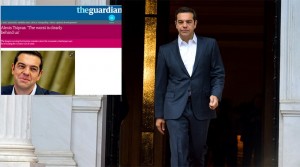
Alexis Tsipras, the Greek prime minister, has promised to defy his critics by taking the country out of its longest-running crisis in modern times. “The worst is clearly behind us,” he told the Guardian in an exclusive interview.
“We can now say with certainty that the economy is on the up … Slowly, slowly, what nobody believed could happen, will happen. We will extract the country from the crisis … and in the end that will be judged.”
It is two and a half years since Tsipras assumed power. An improbable leader at the start of Athens’s great economic debt drama, the former communist youth activist is now the longest serving premier in the eight years for which Greece has struggled to keep bankruptcy at bay.
Yet it has been at immense cost, and while facing at times megaphone criticism, that has clearly hurt. “When I came into this office, I had no experience, or sense, of how big the day-to-day difficulties would be,” he concedes. “I think, now, I have a very different picture from the one I had initially.”
Two summers on, Tsipras is in reflective mood. At barely 42, responsibility, and the realities of governing, weigh heavy. “I have made mistakes … big mistakes,” he says, adding that his biggest error may have been “the choice of people in key posts”. It seems a direct reference to his first finance minister, the maverick eonomist Yanis Varoufakis, whose alternative plan to accepting ever more austerity in return for bailout funds Tsipras dismisses as “so vague, it wasn’t even worth talking about”.
In 2015, Tsipras’s radical Syriza party was the great anti-austerity hope in the nation that, debt-choked and insolvent, threatened to tear Europe’s economic union apart. It was under threat of euro ejection – and, say aides, the risk of Greece being turned “into Afghanistan” – that the young politician, the global pinup of the far-left anti-establishment movement, eventually compromised by accepting a bailout programme whose excoriating terms were harsher than those that had been rejected by more than 61% of voters in a referendum only days before.
The fallout from the U-turn has been colossal. Syriza’s popularity has plummeted; Tsipras’s own ratings have nosedived. Some polls show the leftists trailing by as many as 16 points, others less, but all seem to reflect a view that the charismatic politician “lied” by adopting the virulent neoliberal budget cuts and tax rises he had once vowed to overturn.
On the leafy avenue outside the neoclassical villa that houses his office, there have been days when pensioners – among the biggest losers in Greece’s ordeal by bankruptcy – have been teargassed while protesting. Almost hourly, the media lists the indignities and depredations visited on a people hollowed out by record levels of poverty and unemployment, byproducts of the downward economic spiral brutal fiscal adjustment has imposed.
The leftists’ unnatural cohabitation with the far-right Independent Greeks – the result of a wafer-thin majority when Tsipras won a second mandate in September 2015 – has spawned accusations that Syriza’s pre-eminent concern is political survival and the trappings of power.
The eurozone’s weakest link is far from being out of the woods. With a debt load close to a staggering €340bn, or 180% of GDP, economic recovery is still a distant dream. The net worth of Greek households fell by 40% between 2009, when the crisis erupted, and 2014. For many, the noose is tightening, with authorities raiding the bank accounts of private debt holders and stepping up confiscations of properties. More than 1 million Greeks, or 21.7% of workers, are unemployed, down from 27.9% in 2013. Among Tsipras’s goals is a 10 percentage point drop in joblessness, but that is “in the next five years”.
Yet headway has been made. Talks with eurozone creditors, seemingly interminable and problem-plagued, are finally over following the disbursement of €8.5bn in emergency funding earlier this month. Capital controls imposed to thwart a bank run, after the collapse of the banking system in the heady days of June 2015, have been relaxed.
Amid speculation of Athens’s imminent return to markets – the first in a series of test runs seen as crucial if the country is ever to wean itself off borrowed money – the leader is keen to exploit the signs of light at the end of the tunnel.
Last week, the International Monetary Fund, the toughest of lenders shoring up the Greek economy since the first of three gargantuan bailouts in May 2010, agreed “in principle” to participate in the latest €86bn rescue programme – even if approval is contingent on the 19-member euro bloc providing much-needed debt relief. With fiscal measures also legislated, and a horizon free of elections until September 2019, he can, he says, get on with the business of governing; of applying an agenda more in line with the liberal values of his party. To this end, laws aimed at alleviating hardship, starting with reconstruction of the shattered welfare state, are in the pipeline.
more at: theguardian.com
author: Helena Smith
Ask me anything
Explore related questions