





Imagine you’re an astronomer with bright ideas about the hidden laws of the cosmos. Like any good scientist, you craft an experiment to test your hypothesis.
Then comes bad news – there’s no way to carry it out, except maybe in a computer simulation. For cosmic objects are way too unwieldy for us to grow them in Petri dishes or smash them together as we do with subatomic particles.
Thankfully, though, there are rare places in space where nature has thrown together experiments of its own – like PSR J0337+1715. First observed in 2012 and announced in 2014, this triple system is 4200 light years away in the constellation Taurus.
Its three dead stellar cores are winding through a ballet that could confirm – or revise – Einstein’s ideas about space-time. The stakes are high. In the 1970s, a system of two dead stars provided strong, albeit indirect, evidence backing Einstein’s theory of general relativity, and that the gravitational waves LIGO would eventually find actually existed. For that work, the researchers would eventually earn the Nobel prize.
Since announcing the triple system, its discoverers have kept mum on their progress. I figured it couldn’t hurt to check.
Screaming bright
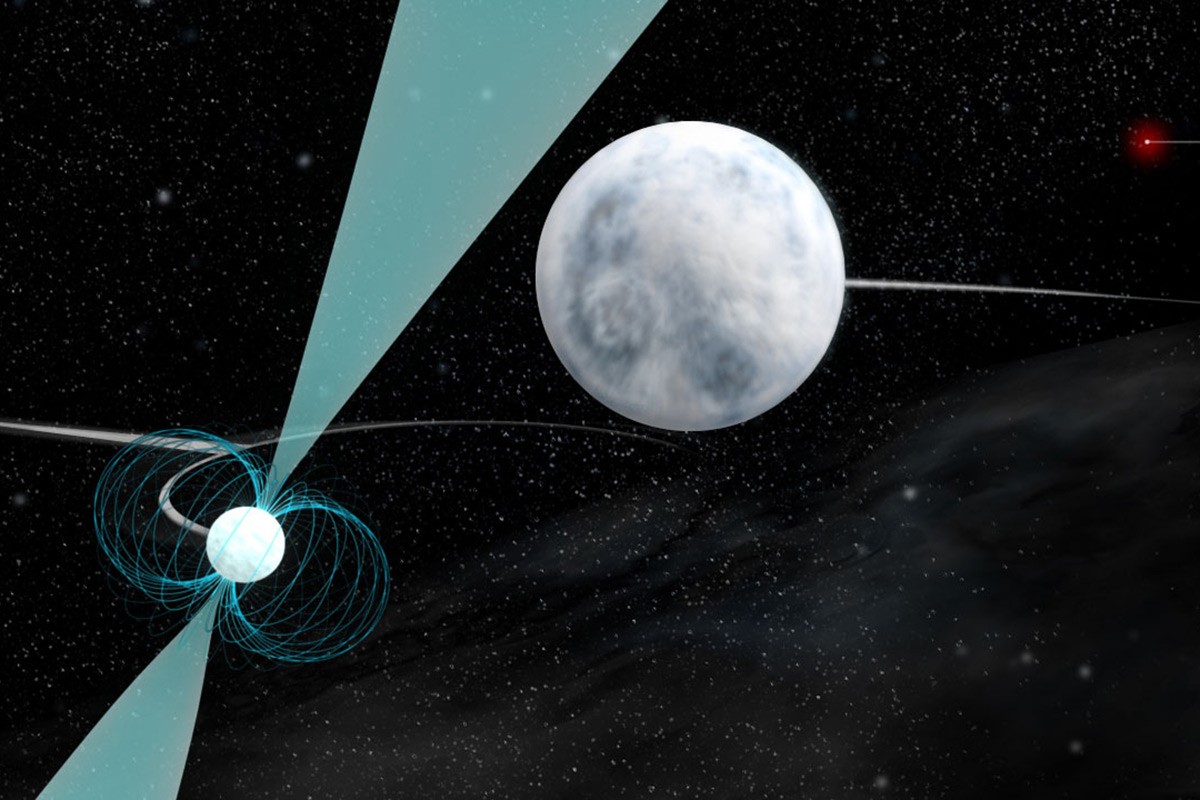
To understand PSR J0337+1715 as an experiment, it helps to understand it as a physical place. At about the same distance from the system’s centre as Earth orbits the sun is a cold white dwarf, the leftover, hardened core of sunlike star. Further in, there’s another, hotter white dwarf. This one would be “screaming bright” in the sky, says Scott Ransom at the National Radio Astronomy Observatory in Virginia, who is leading the observations of the system.
Every 1.6 days, that inner white dwarf twirls around a companion invisible to the naked eye. But in X-ray or gamma-ray vision, the two white dwarfs would look feeble relative to the companion – a 24-kilometre-wide spherical object with almost one and a half times the mass of the sun.
This one is a pulsar, the remnant of a much larger star. It pirouettes maniacally once every 2.73 milliseconds, like a cosmic whirling dervish. Each spin sweeps a lighthouse beam of radio waves across the sky, alighting on Earth with each pass – meaning that we have a tick mark for every single rotation of the pulsar going back years, like a hyper-accurate clock. And since these bodies have intense, tangled gravitational fields and we have a clock that moves through them, testing Einstein is fair game.
Ransom’s team has been timing the pulsar’s ticking, tracking how the orbits of the three bodies change, and comparing the results with what Einstein’s theory predicts. One idea in particular is in their crosshairs.
Think about the apocryphal story of Galileo at the Leaning Tower of Pisa, dropping objects to show that different masses take the same time to fall the same distance, or astronaut David Scott trying out the experiment on the moon with a feather and a hammer.
General relativity’s so-called strong equivalence principle is an extension of this idea. It holds that even objects with their own strong gravitational fields should respond to gravity in the same way as one another.
Like the feather and the hammer, the inner white dwarf and the much heavier pulsar should act similarly under the gravitational pull of the outer white dwarf. If not, the orbit of the inner pair will become more elliptical than expected – in which case the equivalence principle is violated and general relativity is wrong.
That would be a shock. But it’s the sort of shock that could be expected sooner or later, since general relativity is infamous for not meshing with our other theories of nature.
“Every other theory of gravity besides general relativity basically predicts that the strong equivalence principle fails at some level,” Ransom says.
At a pulsar conference in the UK in September, Ransom’s team hopes to announce new results, from work led by postdoc Anne Archibald, that will test the equivalence principle 50 to 100 times better than ever before. They haven’t done so already, Ransom says, because they need to look more closely at some patterns in the data that appear to violate the equivalence principle.
“Obviously that would be a huge deal, so we wanted to really make sure that we understood our data,” Ransom says. Right now, computers are still churning through the analysis.
I had to ask Ransom: what are the chances everyone will freak out when you come out with your paper?
“Most people believe that the strong equivalence principle is not going to fail at these levels,” he says. “This is one of the reasons why we are beating our heads against the wall every possible way.”
Maybe PSR J0337+1715 is the perfect cosmic experiment: one in which general relativity clearly breaks down, not on a sheet of equations or in a simulation. Or maybe we’ll just have to keep waiting.
Ask me anything
Explore related questions