




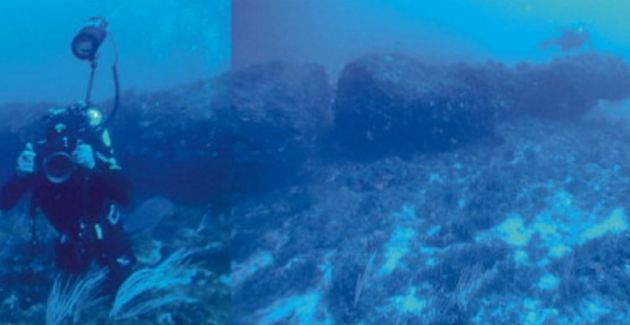
Off the coast of Sicily, a strange monolith has been found on the seabed. Experts say the structure was built around 10,000 years ago. They believe it was built and not formed because it has three holes that could not have formed naturally.
This discovery could shed some much-needed light on the civilizations that inhabited the Mediterranean basin. The archaeologists used geological and geophysical methods to survey the area.
Emanuele Lodolo of the National Institute of Oceanography and Experimental Geophysics in Trieste, Italy, and Zvi Ben-Avraham, of Tel Aviv University, said in an article published in the Journal of Archaeological Science: “There are no reasonable known natural processes that may produce these elements.”
The monument was lying 131ft under the water near an island that was once called Pantelleria Vecchia Bank in the Sicilian Channel.
A flood that happened 9,500 years ago, after the Last Glacial Maximum, submerged the island. The Last Glacial Maximum was the most recent period in the Earth’s climate history where the ice sheets were most prominent.
(Click to enlarge)
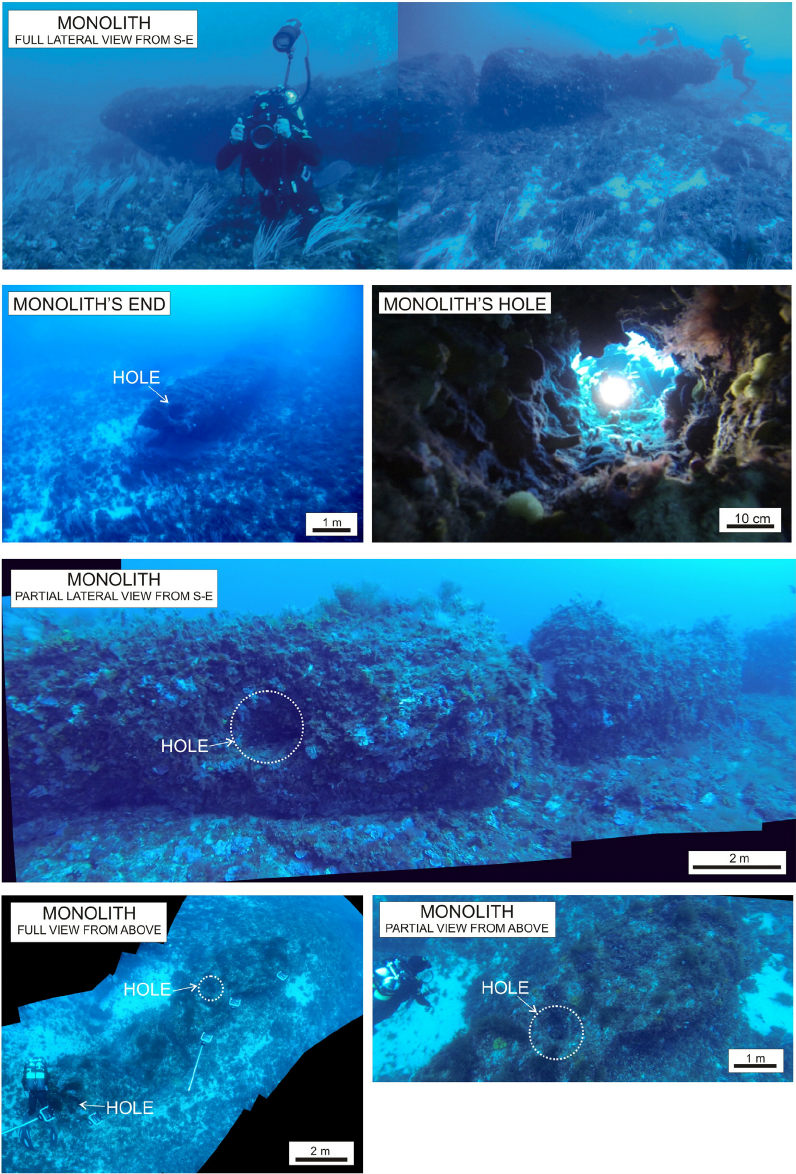
(Underwater composite photographs taken from divers, showing the discovered monolith and some details)
“Considering its shape and length, it can be called a Stonehenge-type monolith, but its age is remarkably older,” Dr. Emanuele Lodolo, a marine geophysicist at the National Institute of Oceanography and Experimental Geophysics in Trieste, Italy and co-author of a new paper describing the discovery.
Experts have a side that: “The Sicilian Channel is one of the shallow shelves of the central Mediterranean region where the consequences of changing sea-level were most dramatic and intense, the ancient geography of the Mediterranean Basin was profoundly changed by the increase in sea level following the Last Glacial Maximum.
This global event has led to the retreat of the coastlines, especially in lowland areas and shallow shelves, such as the Sicilian Channel.”
This discovery tells researchers that ancient civilizations may have once lived here and also colonized others nearby. It was determined that before the flood, the Sicilian Channel was connected to Sicily.
It formed a peninsula that was separated from North Africa by only 30 miles.
With only the highest points not being flooded, it created an archipelago of islands in a shallow sea, including Pantelleria Vecchia Bank.
The study said: ‘This discovery provides evidence for a significant Mesolithic human activity in the Sicilian Channel region.’
In an interview with Discovery News, Dr. Lodolo stated: “This discovery reveals the technological innovation and development achieved by the Mesolithic inhabitants in the Sicilian Channel region, before the island was submerged 9,500 years ago.”
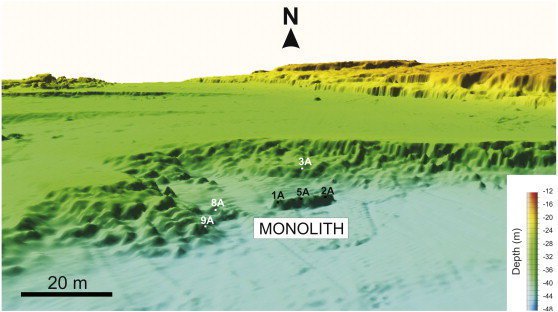
(It was discovered by a diver on Sept. 16, 2014 at a depth of about 40 meters on what was once an island in the Sicilian Channel)
The monolith is not a collection of different stones but was actually cut from one; this shows how the ancient culture was about to extract, transport, cut and install the monument.
“Such an effort undoubtedly reveals important technical skills and great engineering,” he said.
The site was most likely used as a lighthouse for the community since their main trade was fish. It could of even of been used as a spot to anchor boats says Dr. Lodolo.
They do not know if the stone was once part of a larger structure like Stonehenge, which is much younger, constructed around 2,600BC, or if it has always stood alone.
The paper was published in the September 2015 issue of the Journal of Archaeological Science.
Stonehenge in Wiltshire was built to be aligned with the sunset of the winter solstice and the sunrise of the summer solstice; it is thought to of been used by ancient people to survey the heavens.
Some believe it was also a meeting point for ancient people. They may have used to as a religious site where people would come to worship their ancestors.
Others suggest it was a place for the dead, or maybe a place of healing because the bluestones could be struck to make a noise which was believed to have mystic or healing powers.
Dr. Lodolo believes this and other submerged settlements in the Mediterranean Sea will help fill in the gaps about ancient cultures that were once in the region.
Ask me anything
Explore related questions