





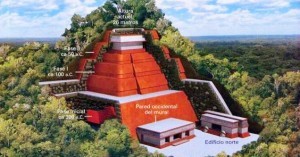
Researchers in Mexico have discovered an immense pyramid, even larger that Teotihuacan’s Pyramid of the Sun. It’s 75 meters in height and was explored by specialists from the National Institute of Anthropology and History. It is located in the acropolis of Tonina, Chiapas and is likely around 1,700 years old.
The director of the archaeological zone, Emiliano Gallaga, says that the work, done over the course of two years, verified that the northeastern portion of the site was, indeed, the largest pyramid in Mexico. It is comparable to pyramids found in Tikal and El Mirador of the Mayan civilization.
One unique feature is the seven platforms that serve as palaces, temples, housing, and what were essentially administrating offices. This unique structure functioned within social, religious, and political cultural structure.
“It’s a big surprise to see that the pyramid was done almost entirely by pre-Hispanic architects and therefore is more artificial than natural,” says Gallagas. “This is because it was believed that the entire structure was a natural hill, but recent evidence has revealed that the structure was almost entirely built by ancient inhabitants.” Archaeologists noted that the pyramid was much larger than they expected it to be. The structure has roads running through it as well.
The temple-pyramid complex was built in four stages, starting from the 3rd century BC through the 9th century AD, and was dedicated to the deity Quetzalcoatl. It has a base of 450 by 450 metres (1,480 by 1,480 ft) and a height of 66 m (217 ft).
According to the Guinness Book of Records, it is in fact the largest pyramid as well as the largest monument ever constructed anywhere in the world, with a total volume estimated at over 4.45 million cubic metres, even larger than that of the Great Pyramid of Giza in Egypt, which is about 2.5 million cubic metres.
However the Great Pyramid of Giza is higher at 138.8 metres (455 ft). The ceramics of Cholula were closely linked to those of Teotihuacan, and both sites appeared to decline simultaneously. The Postclassic Aztecs believed that Xelhua built the Great Pyramid of Cholula.
At its peak, Cholula had the second largest population in Mexico of an estimated 100,000 people living at this site. Although the prehispanic city of Cholula continued to be inhabited, the Great Pyramid was abandoned in the 8th century at a time when the city suffered a drastic drop in population. Even after this drop-off in population, the Great Pyramid retained its religious importance. The site was once called Acholollan (in Nahuatl) meaning place of flight.
This meaning has led some to believe that this site was founded after its original inhabitants fled (from?) elsewhere. According to myth, the pyramid was built by a giant named Xelhua of adobe bricks, after he escaped a flood in the neighboring Valley of Mexico.
The pyramid consists of six superimposed structures, one for each ethnic group that dominated it. However, only three have been studied in any depth. The pyramid itself is just a small part of the greater archaeological zone of Cholula, which is estimated at 154 hectares (0.59 sq mi).
Building of the pyramid began in the Preclassic Period and over time was built over six times to its final dimensions of 450 metres on each side at the base and 66 metres tall. This base is four times the size of that of Pharaoh Khufu’s Great Pyramid of Gizaand is the largest pyramid base in the Americas.
The earliest construction phase features talud-tablero architecture that is characteristic of the region, and that became strongly associated with the great metropolis of Teotihuacan. Some of the pyramid constructions have had burials, with skeletons found in various positions, with many offerings, especially ceramics.
The last state of construction has stairs on the west side leading to a temple on top, which faced Iztaccíhuatl. During the colonial period, the pyramid was severely damaged on its north side in order to build the Camino Real to Puebla. The west was damaged later with the installation of a rail line.
This meaning has led some to believe that this site was founded after its original inhabitants fled (from?) elsewhere. According to myth, the pyramid was built by a giant named Xelhua of adobe bricks, after he escaped a flood in the neighboring Valley of Mexico.
The pyramid consists of six superimposed structures, one for each ethnic group that dominated it. However, only three have been studied in any depth. The pyramid itself is just a small part of the greater archaeological zone of Cholula, which is estimated at 154 hectares (0.59 sq mi).
Building of the pyramid began in the Preclassic Period and over time was built over six times to its final dimensions of 450 metres on each side at the base and 66 metres tall. This base is four times the size of that of Pharaoh Khufu’s Great Pyramid of Gizaand is the largest pyramid base in the Americas.
The earliest construction phase features talud-tablero architecture that is characteristic of the region, and that became strongly associated with the great metropolis of Teotihuacan. Some of the pyramid constructions have had burials, with skeletons found in various positions, with many offerings, especially ceramics.
The last state of construction has stairs on the west side leading to a temple on top, which faced Iztaccíhuatl. During the colonial period, the pyramid was severely damaged on its north side in order to build the Camino Real to Puebla. The west was damaged later with the installation of a rail line.
Ask me anything
Explore related questions