





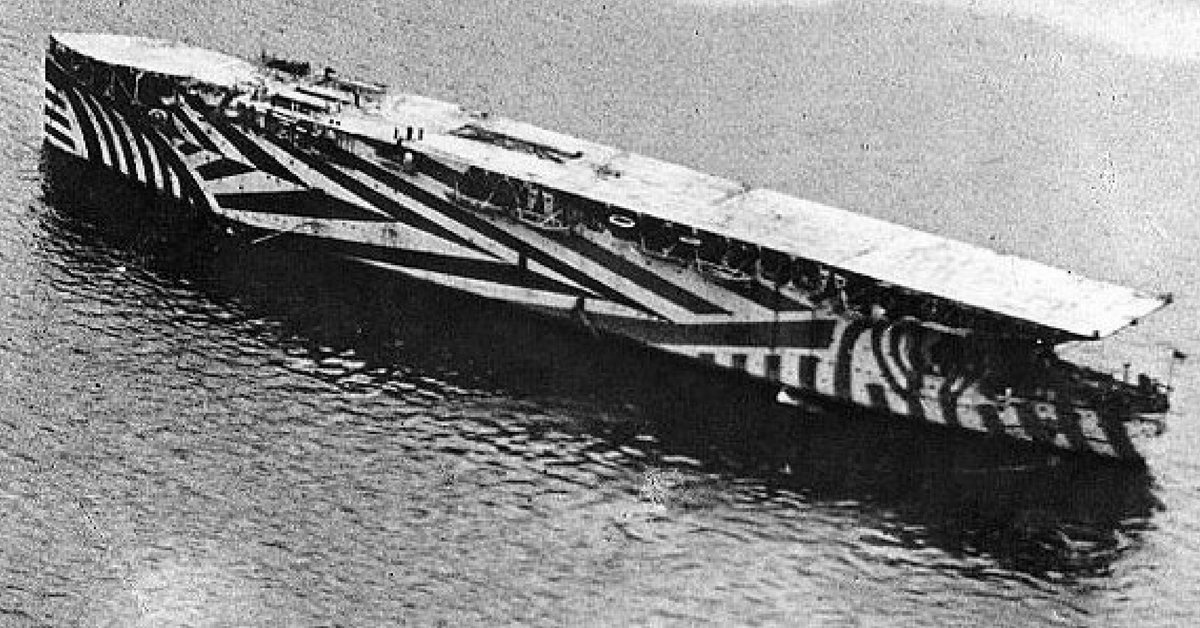
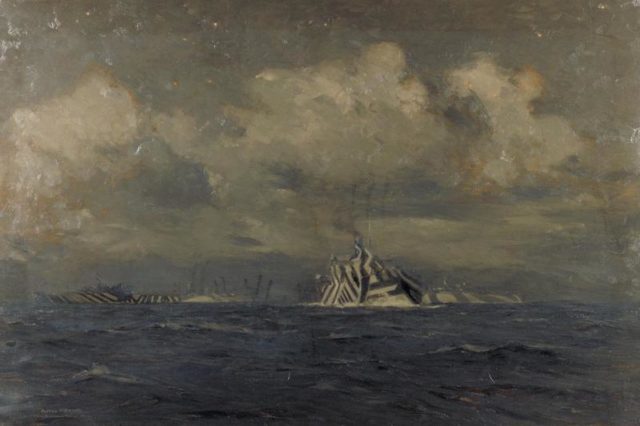
Ships were painted with zebra stripes in hopes of evading and deceiving the enemy during World War I. It was not entirely clear how effective the “dazzle” camouflage was, but a recent study seems to indicate that the zigzag-like patterns can be misleading and deceptive when the ship is moving.
A British marine artist Norman Wilkinson came up with the dazzle camouflage idea. The goal is not to hide the ship, but rather to trick the combatants behind enemy lines. The ships that were painted with the zigzag pattern became difficult to pin down, which made it harder to guess the speed, range, and goal of the target.
This form of camouflage was utilized by both the United States and the British Navy. Of course, each ship showed off a different pattern to prevent the enemy from identifying classes of ships. The success of the dazzle was varied and as a result, the strategy was phased out even though some of the ships kept these patterns during World War II. The technique is considered antiquated in today’s day and age.
The journal Public Library of Science (PLOS 1), published a new study that revealed how the dazzle technique could be bettered. Dazzle is more effective when it is not static – it needs to be moving. Joanna Hall is a researcher who works out of CampLab at the University of Bristol. She conducted a series of experiments that demonstrated how moving patterns located on a target can twist and warp our perception when it comes to the speed of the object.
Hall and her colleagues relied on computer-based visuals. They wanted to understand how the perceived speed of a target is affected by a moving pattern. The result of their research showed that when a pattern on a target moves in the same direction as the target, it makes it seem like the target is moving quicker than it is. When the pattern moves in the opposite direction to the target, it seems to move more slowly.
The sizes of these targets are equivalent to a Land Rover. Therefore, it can cause a targeting error of up to 6.5 feet (2 meters) at a distance of 230 feet (70 meters) when the vehicle moves at 55 mph (90 km/hr). During maximum effect, the perceived speed could be increased or decreased incorrectly by the onlooker at around 15 percent. The effect seemed to be heightened during more stressful circumstances.

Hall said, “Our research is the first to quantify the effects of a moving pattern on a moving target. We showed that a moving stripe pattern can increase or decrease the perceived speed of a moving target in a reliable and predictable manner.”
Furthermore, the dazzle pattern does not need to cover the entire target to be effective. The researchers were able to determine that the perceived speed of a target will still be distorted even if there is only a tiny patch of the dynamic dazzle at each end. This team did not test their hypothesis on actual Land Rovers or ships, but they believe the concept applies regardless. Hall explained, “If technology were available to construct a surface able to display a moving pattern then, in theory, it could be applied to any object for which it would be useful to disguise the speed.”
One potential military application could be on vehicles with a higher likelihood of being attacked by rocket-propelled grenades. Hall thinks that the distortion in speed perception could cause that aforementioned targeting error by the enemy. This would likely mitigate the risk of a direct hit. Going forward, the researchers are hoping to use these findings and to test the effect within a real world situation. If it works, there is a possibility that we could see a revival of the dazzle camouflage. However, now it would be presented in its more modern and dynamic form.
Ask me anything
Explore related questions