





When first discovered, graphene was odd. Now odd is too small a word for a material seemingly set on winning all the records a material can win.
In the first part of our series, we looked at what graphene is and how it was discovered. In part two, we explored the different techniques we can use to make graphene.
But what is it that makes this material so remarkable? Here are 10 of the strangest facts about graphene.
1. Strength
“The most amazing thing to me about graphene is its strength. This is a sheet of atoms that you can pick up. That blows my mind.”
So says Professor James (Jim) Tour of Rice University in Texas, and who are we to argue with that? A sheet of atoms that you can pick up: say it out loud to yourself a couple of times.
Everyone you ask about graphene’s amazing properties says the same thing: it is really hard to pick one feature when the material is so astonishing. So let’s consider a few more of them.
2. No band gap
Graphene has no band gap. A band gap is the gap between the energy of an electron when it is bound to an atom, and the so-called conduction band, where it is free to move around. An electron can’t have an energy level between those two states.
This makes graphene a wonderful candidate for use in photovoltaic (PV) cells, for instance, because it can absorb photons with energy at every frequency — photons of different frequencies of light are converted to electrons with matching energy levels. A material with a band gap can’t convert wavelengths of light that correspond to the forbidden energy states of the electrons. No band gap means everything is accepted.
This opens the tantalising possibility of highly efficient PV cells, but it’s a problem if you want to use graphene in transistors, where you need the band gap to provide the isolation necessary if you want it to act as a switch that can be turned off.
It is possible to induce a small band gap in graphene by doping it. This is good enough for very fast amplifiers for radio work, but for transistors that make efficient logic circuitry you need a bigger gap.
3. Ballistic conduction
Yes, this is a really weird one: ambient temperature “unimpeded” conduction of electrons. It was observed in multi-walled carbon nanotubes at least as far back as 2002, and since graphene is basically an unzipped carbon nanotube, it does it too.
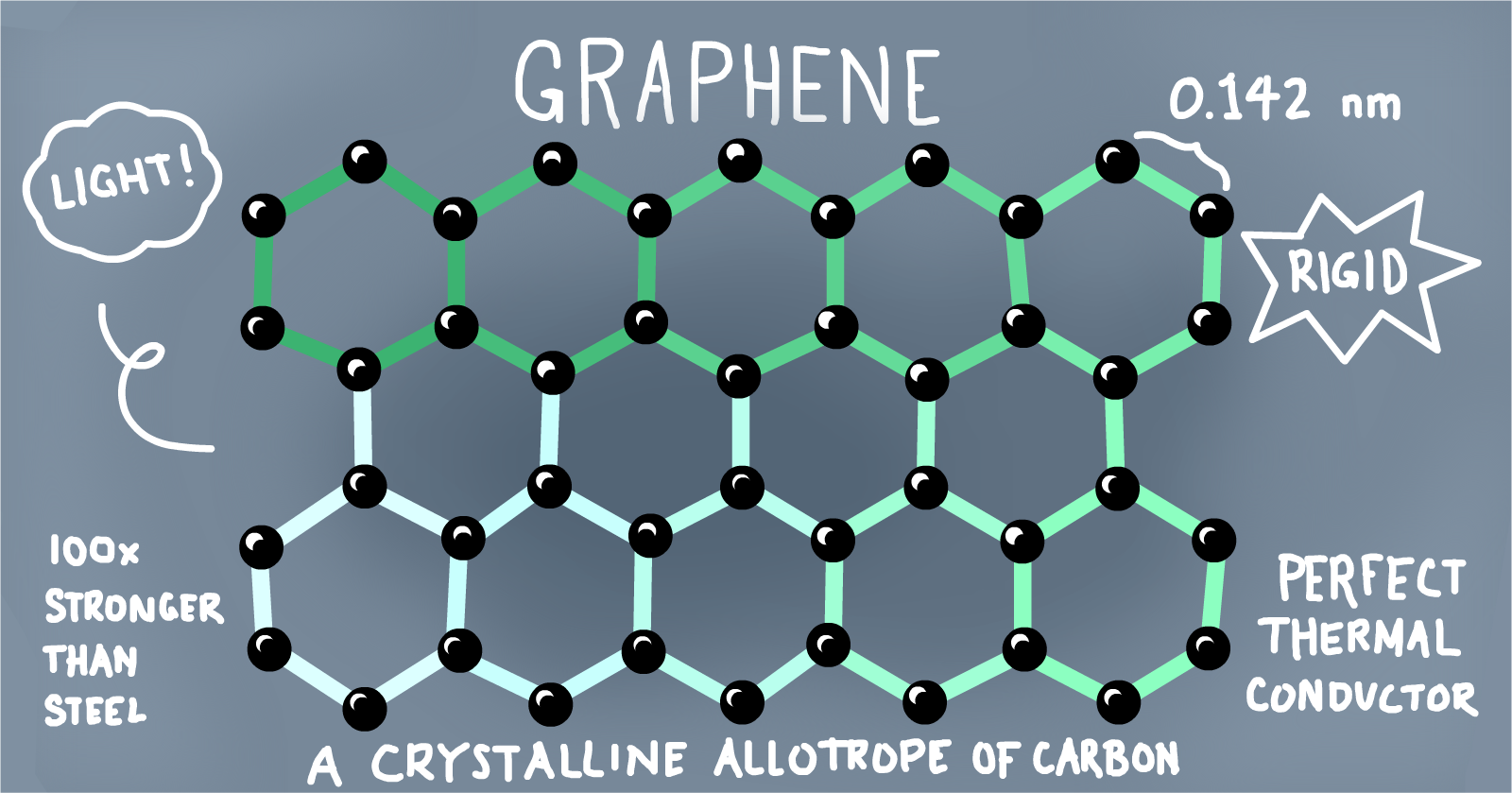
The hexagonal lattice has the longest “mean free path” of any known material — of the order of microns. This is the distance an electron can travel freely without bumping into anything, or having its path disrupted by scattering; the things that induce resistance. When the mean free path is longer than the dimensions of the material, you get ballistic transport.
In graphene, the mean free path is of the order of 65 microns — long enough that electronic components could be made that would operate at ambient temperatures with virtually no resistance. This is similar to superconductivity, but at room temperature.
4, 5 & 6. Best at electricity
And in case that doesn’t impress you, Manchester University’s Dr Leonid Ponomarenko points out that graphene also has “the highest current density (a million times that of copper) at room temperature; the highest intrinsic mobility (100 times more than in silicon); and conducts electricity in the limit of no electrons”. Which means it can carry more electricity more efficiency, faster and with more precision than any other material.
7. Transparency
Back to Professor Tour for this one: “Another amazing thing about graphene is that you can see it. You can lay a sheet on a white piece of paper and actually see it. It is amazingly transparent, absorbing just 2.3 percent of light that lands on it, but if you have a blank sheet to compare it to, you can see that it is there.” That means you can see a single layer of atoms with your naked eye, if they’re graphene.
As well as making graphene even more useful as a potential solar cell component, its transparency makes it ideal for use in touchscreens. Currently most screens are made from Indium Tin Oxide (ITO), which absorbs 10 percent of incident light. But ITO is quite brittle, whereas graphene is extremely…
8 & 9. Elastic
Well, for a crystal, anyway. Graphene stretches up to 20 percent of its length. And yet it is also the stiffest known material — even stiffer than diamond.
10. Thermal conductivity
Graphene also beats diamond in thermal conductivity. In fact, graphene now holds the record for conducting heat — it’s better than any other known material.
11. Impermeable
Here’s one for luck. Graphene is also the most impermeable material ever discovered. “Even helium atoms cannot squeeze through,” Dr Ponomarenko says. This makes it a great material for building highly sensitive gas detectors, for example, since even the smallest quantity of a gas will get caught in its lattice, changing its electrical properties.
All of the above makes graphene a good contender for yet another record: the material with the most records. For a substance that’s only been closely studied since 2004, this makes it the child prodigy of material science, and one well worth the intense interest it continues to generate.
Ask me anything
Explore related questions